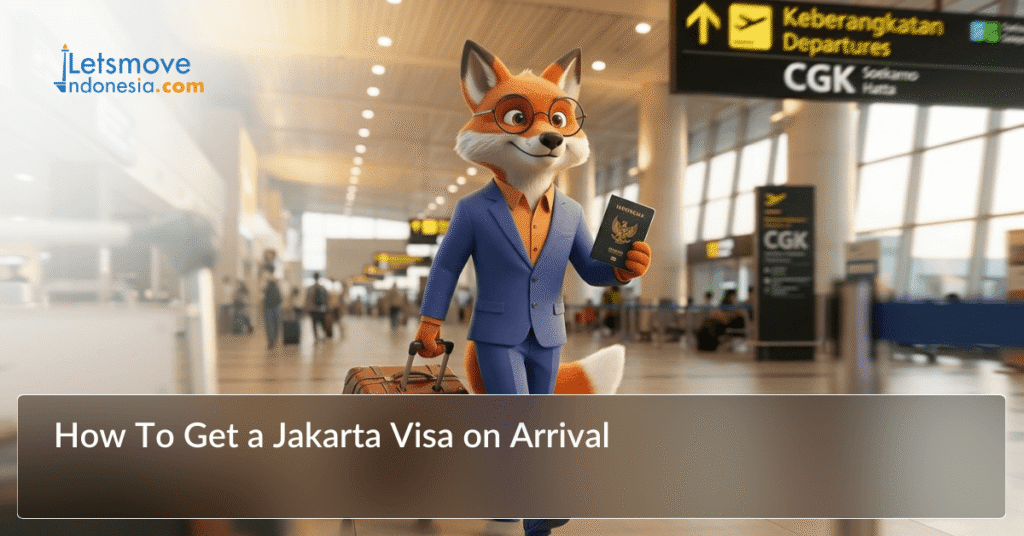
For many travellers, arriving in Jakarta can be remarkably straightforward. If your nationality is eligible, Indonesia’s Visa on Arrival (VoA) allows you to obtain an entry visa without arranging a conventional visa before travelling.
For those travelling to Jakarta, there are 97 nationalities that are eligible to travel with either the physical or e-visa on arrival.
What Is the Indonesia Visa on Arrival?
The Visa on Arrival is a short-term visitor visa type available to eligible foreign nationals entering Indonesia.
Under the current rules, the B1 Visa on Arrival provides an initial stay of up to 30 days and may be extended once, allowing a maximum total stay of 60 days. The visa is for permitted visitor activities and does not provide general permission to work for an Indonesian company or receive remuneration from an Indonesian individual or company.
The current government fee for the VoA is IDR 500,000 per application.
| Visa detail | Current requirement |
| Visa | B1 Visa on Arrival |
| Initial stay | Up to 30 days |
| Extension | One extension |
| Maximum stay | Up to 60 days |
| Government fee | IDR 500,000 |
| Sponsor | Not required |
| Entry | Single entry |
| Application | On arrival or Indonesia e-VoA |
| Work in Indonesia | Not permitted under the B1 VoA |
| e-VoA validity | 90 days from issuance |
The visa is valid for 90 days from the date of issuance for entry and allows you to stay for 30 days begun when the foreign national enters the country.
Who Can Apply for a Jakarta Visa on Arrival?
Eligibility depends on nationality and the applicable Indonesian immigration regulations.
Currently, Indonesia offers this programme to 97 nationalities and certain entities eligible for VoA, including:
| Examples of eligible nationalities | |
| China, India, Japan, South Korea, Malaysia, Singapore, Thailand, Vietnam | |
| United Kingdom, France, Germany, Italy, Netherlands, Spain, Switzerland | |
| United States, Canada, Argentina, Brazil, Chile, Mexico | |
| Saudi Arabia, Qatar, Kuwait, Oman, Bahrain, United Arab Emirates | |
| Australia, New Zealand, Papua New Guinea | |
| South Africa, Egypt, Kenya, Rwanda, Tanzania, Mozambique | |
| Hong Kong, Macau, Taiwan and Timor-Leste |
The official list currently contains 97 eligible nationalities. Because visa updates can occur, travellers should verify their nationality against the latest Indonesian Immigration list before making travel arrangements.
What Do You Need for a Visa Application?
The application process is relatively simple, but the passport requirements should be checked before departure.
For an Indonesia Visa on Arrival, travellers should have:
- A valid national passport;
- A passport valid for at least six months from the date of arrival;
- The applicable visa payment; and
- A return or onward ticket where required by immigration.
Foreign nationals travelling on temporary, emergency or other non-standard travel documents may not be eligible for the VoA. Indonesian Immigration specifically states that certain travel documents other than a national passport cannot be used for the VoA application.
The previous requirement for a COVID-19 vaccination certificate should no longer be treated as a standard VoA document requirement in a current 2026 guide.
How Does the Indonesia e-VoA Application Work?
Eligible applicants can submit their application and payment electronically before travelling through the official immigration visa platform.
The basic process is:
- Check eligibility
- Prepare passport details
- Complete the e-VoA application
- Make payment
- Receive the electronic visa
- Travel to Indonesia.
An e-VoA can make arrival more convenient because the visa has already been arranged before the traveller reaches the immigration counter.
However, obtaining an e-VoA does not guarantee entry. Indonesian immigration authorities retain the authority to assess a traveller upon arrival.
Where Can You Enter Indonesia Using a Visa on Arrival?
Eligible travellers can use the facility at designated international entry points. For someone travelling to Jakarta, the relevant airport is Soekarno-Hatta International Airport.
Can You Extend a Visa on Arrival Within Indonesia?
A B1 VoA can be extended once for another 30 days, bringing the maximum stay to 60 days.
For travellers staying in Jakarta, this means the process can generally be handled without leaving Indonesia solely to obtain the extension.
The important point is timing: do not wait until the final day of your permitted stay.
Is the Indonesia e-VoA Easier to Extend?
For e-VoA holders, the extension process can be completed online through the immigration system, subject to the applicable requirements.
This is one of the practical advantages of arranging the e-VoA rather than obtaining a physical VoA at the airport. However, the extension remains subject to Indonesian immigration rules and the applicable stay period.
A visa extension also does not change the underlying purpose of the visa. If your plans change from tourism to employment, long-term residence or another activity requiring a different visa category, simply extending the VoA may not be the appropriate solution.
Can You Use a Visa on Arrival for Business in Indonesia?
This depends on what you mean by business. A VoA can cover certain visitor activities, including attending meetings, conferences, exhibitions and similar activities. However, it is not a general work permit.
The B1 Visa does not permit the holder to sell goods or services or receive remuneration, wages or similar compensation for work or business activities from an Indonesian individual or corporation.
If your purpose involves actually working for a company in Indonesia, receiving local income or carrying out activities that fall under a work visa category, you should assess the appropriate visa options before starting those activities.
What If You Need Multiple Entries or a Longer Stay?
A VoA is designed for a short visit and does not provide multiple entries.
If you expect to leave Indonesia and return regularly, a Multiple Entry Business Visa or another multiple-entry visa category may be more suitable, depending on the purpose and duration of your stay.
Likewise, someone planning long-term residency may need to consider a KITAS or another appropriate limited-stay visa rather than repeatedly relying on short-term visitor arrangements.
When Is a KITAS More Appropriate Than a Visa on Arrival?
A KITAS, by contrast, belongs to Indonesia’s longer-term stay framework and is available for different purposes, including employment, investment, family reunification and other qualifying activities.
For example, someone married to Indonesian citizens may need to examine a family-based stay route rather than repeatedly using a visitor visa. Similarly, foreign investors setting up a company may need to consider investor-related visa categories.
A spouse KITAS, investor arrangement or employment-related KITAS can therefore be more appropriate where the person’s circumstances extend beyond a temporary visit.
Can You Apply for a Spouse KITAS While Using a Visa on Arrival?
This depends on the individual’s circumstances and the applicable immigration mechanism.
Indonesia provides family-based visa and stay options for foreign nationals married to Indonesian citizens, but the appropriate application process should be assessed before assuming that a VoA can simply be converted into a spouse KITAS.
If your intention is to remain in Indonesia with your Indonesian spouse, it is generally better to review the relevant family visa options before your existing stay permission approaches its expiry.
Do You Need a Sponsor for a Visa on Arrival?
One of the advantages of the VoA is that a sponsorship is not required for the application. Indonesian Immigration specifically states that the B1 VoA does not require a sponsor.
This differs from several other Indonesian visa categories where an individual or company may need to act as a sponsor or provide supporting documentation.
What Happens If You Want to Stay in Indonesia Beyond 60 Days?
Once the maximum permitted stay under the VoA has been reached, you cannot simply keep extending the same visa indefinitely.
If your plans involve a longer stay in Indonesia, you should assess alternative visa options before reaching the end of your permitted period.
Depending on your circumstances, this could include a longer-term visitor visa, a KITAS, an investor visa, a family-based visa or another appropriate immigration category.
For someone considering setting up a company, working in Indonesia or pursuing long-term residency, early immigration planning can also prevent unnecessary changes of status or interruptions to the application process.
Frequently Asked Questions About the Indonesia Visa on Arrival
How long can I stay in Indonesia using a VoA?
The B1 Visa on Arrival allows an initial stay of up to 30 days and can be extended once for another 30 days, for a maximum total stay of 60 days.
How much does the Indonesia Visa on Arrival cost?
The government fee is IDR 500,000 for the B1 VoA.
Can I apply for an Indonesia e-VoA before travelling?
Yes. Eligible foreign nationals can apply for the electronic Visa on Arrival before entering Indonesia through the official immigration visa platform.
Can I extend my e-VoA?
Yes. The stay permission under the e-VoA can be extended once, subject to the applicable requirements, and the immigration authority provides an online extension mechanism for e-VoA holders.
Can I work using a Visa on Arrival?
No. A B1 VoA does not provide general permission to work for an Indonesian company or receive local remuneration.
Can I use a VoA for a Business Visa?
The VoA permits certain business-related visitor activities, such as meetings and exhibitions, but it should not be treated as a general Business Visa or work authorisation. Activities must remain within the permitted scope of the visa.
Can I enter Indonesia multiple times with a VoA?
No. The B1 VoA is for single entry. If you require multiple entries, you should consider a visa category specifically designed for multiple travel.
How Can Lets Move Indonesia Help With Your Visa in Jakarta?
Indonesia’s visa system is relatively straightforward when your travel purpose is straightforward. The complexity begins when your plans change, when a holiday becomes an extended stay, a business trip develops into an investment, or a temporary visit becomes the beginning of a longer life in Indonesia.
Lets Move Indonesia helps foreign nationals, foreign investors and businesses navigate Indonesia’s immigration requirements, from short-term visitor arrangements to longer-term visa categories.
Planning your Visa in Jakarta or elsewhere in Indonesia?
Speak with Lets Move Indonesia before you travel or before your current stay expires, and let our team help you find the right visa services option for your plans.
More article suggestions for Visa Updates and Insights on Indonesia Company Corporation
The Indonesia Visa on Arrival – Everything you need to know now!