The Directorate General of Immigration under the Ministry of Immigration and Correctional Services (Imipas) has officially launched the first true permanent residence permit. This policy establishes a lifelong residency pathway specifically tailored for individuals with strong historical, familial, or cultural ties to Indonesia.
Authorised by Imipas Minister Agus Andrianto on 19 November 2025, the GCI program positions Indonesia alongside global diaspora-recognition systems such as India’s Overseas Citizenship of India (OCI).
For many years, former Indonesian citizens (Ex-WNI/Diasporas) and their descendants navigated a patchwork of temporary stay permits, annual renewals, sponsorship obligations, and limited long-term security. Indonesia had no mechanism that allowed eligible foreigners with Indonesian roots to reside permanently without reapplying or depending on third-party sponsorship.
For the first time, individuals with Indonesian lineage can secure permanent, multi-entry residency in Indonesia, reflecting a progressive step in the nation’s outreach to its global diaspora. This article presents our professional consultant’s answers to the frequently asked questions that have come up since the GCI program was released.
What is GCI?
The Global Citizenship Indonesia (GCI) is Indonesia’s first-ever unlimited stay permit, offering permanent residency to eligible foreigners. Unlike KITAS or KITAP, which require sponsors and periodic renewals, GCI provides:
- Lifetime residency (unlimited stay permit)
- Multi-entry re-entry permit
- No citizenship renunciation
- A secure legal foundation for diaspora families
It is built to replace decades of ambiguity for former Indonesian citizens, second-generation diaspora, mixed-nationality families, and foreign spouses.
Minister Agus emphasized that GCI resolves long-standing dual citizenship debates without changing Indonesia’s single-citizenship doctrine. Instead, it introduces a new residency category that honours heritage, family bonds, and Indonesia’s global diaspora footprint.
Who Is GCI For?
Keep in mind that GCI is not a general residency visa. It is exclusively available to individuals with verifiable Indonesian ancestry or close cultural-familial connections.
Eligible Applicants
- Ex-Indonesian citizens (Ex-WNI)
- First-degree descendants of Ex-WNI
- Second-degree descendants of Ex-WNI
- Indonesian spouses of foreign citizens
- Mixed-nationality children who previously held dual nationality until age 18
Not Eligible
- Citizens of countries historically part of Indonesia’s territorial region
- Individuals involved in separatist movements
- Current or former foreign military, intelligence, law enforcement, or civil service personnel
- Individuals involved in activities undermining Indonesia’s national interests
The strict restrictions reflect Indonesia’s stance on sovereignty and national security while ensuring the program remains aligned with its diaspora-focused intent.
How many visa categories exist under the Global Citizenship of Indonesia (GCI) program?
The Global Citizenship of Indonesia (GCI) program consists of four official visa categories, each created for a different segment of the Indonesian diaspora and their descendants. Here’s a quick overview of the key information you should know about each visa type.
1. Former Indonesian Citizens / Ex-WNI (E32E)
For: Ex-WNI who naturalised in another country and wishes to permanently reside in Indonesia.
Definition
Individuals who previously held Indonesian citizenship and later obtained citizenship of another country.
Stay Permit
- Unlimited Stay Permit
- Issued with 5-year plus validity (unlimited duration)
What You Can Do
- Conduct non-contractual work activities
- Bring eligible family members to Indonesia
- Travel freely in and out of Indonesia while the re-entry permit is valid
- Engage in tourism, family visits, and cultural activities
What You Cannot Do
- Receive salary or income from Indonesian companies or individuals
- Sell goods or services inside Indonesia
- Hold political office or exercise citizenship rights
Your Obligations
- Show proof of financial sufficiency
- Honour all Indonesian laws and cultural norms
- Submit proof of commitment fulfillment within 90 days
- Maintain full compliance with immigration regulations
Document Requirements
- Passport valid for at least 6 months
- Proof of funds (min. USD 2,000)
- Curriculum Vitae and recent photo
- Proof of former Indonesian citizenship (KTP, KK, RI passport, birth certificate, diploma, or property ownership)
- Commitment fulfillment of at least USD 10,000 in:
- Government bonds, OR
- Publicly listed shares, OR
- Mutual funds, OR
- Deposit in a state-owned bank, OR
- Property purchase (min. USD 100,000)
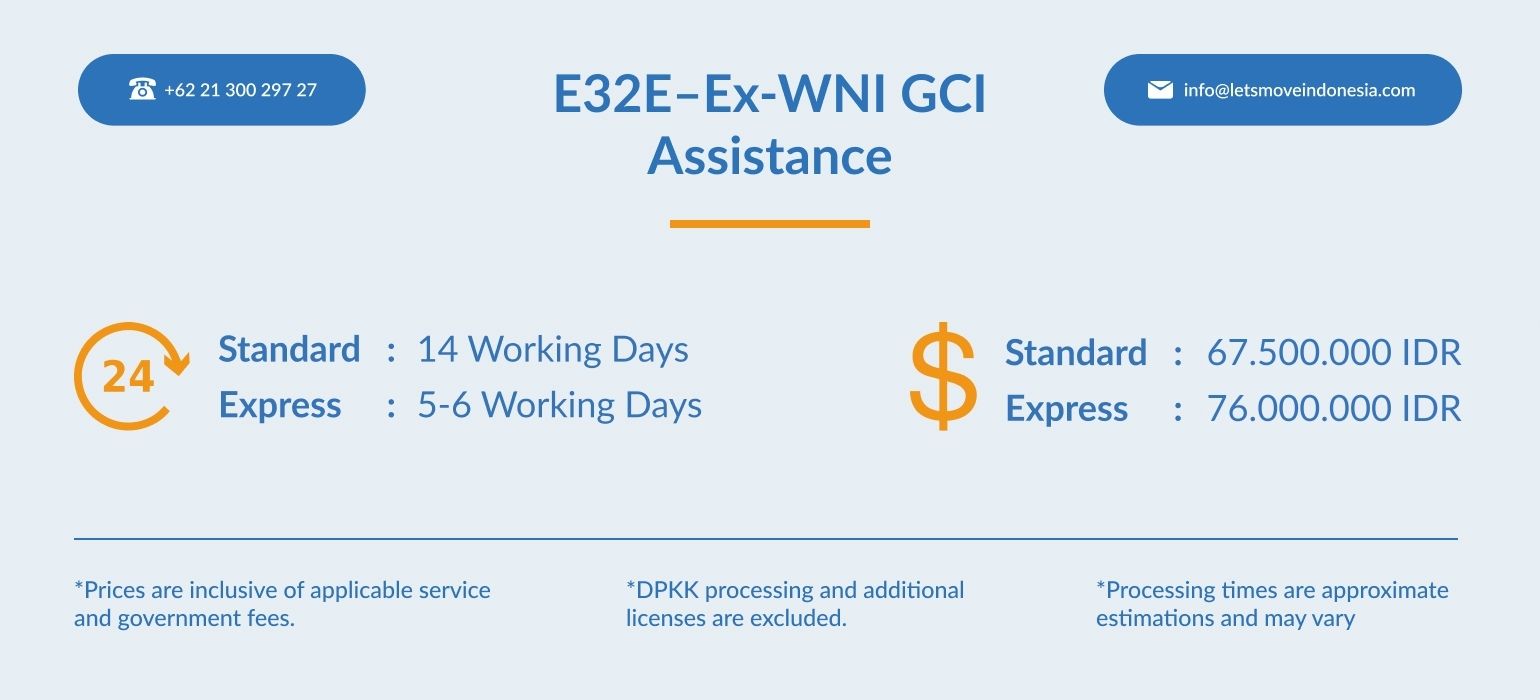
2. Former Indonesian Citizens With Special Skills / Talents Collaborating With the Government (E32F)
For: Ex-WNI with recognised expertise, achievements, or contributions who are invited or approved to collaborate with the Indonesian Government.
Definition
A special category for former Indonesian citizens who possess special talents and intend to collaborate with the Government of Indonesia while residing permanently in Indonesia.
Stay Permit
- Unlimited Stay Permit
- Issued with 5-year plus validity (unlimited duration)
What You Can Do
- Conduct non-contractual work
- Bring family under applicable immigration rules
- Travel in and out of Indonesia with re-entry permit
- Engage in cultural, social, or family activities
What You Cannot Do
- Receive wages in Indonesia
- Sell goods or services
- Hold political or citizenship-related positions
Your Obligations
- Financial sufficiency
- Respect laws and cultural norms
- Submit proof of commitment fulfillment within 90 days
- Comply with immigration rules
Document Requirements
- Passport valid for at least 6 months
- Financial proof (min. USD 2,000)
- CV and recent photograph
- Proof of former Indonesian citizenship (KTP, KK, RI passport, etc.)
- Commitment fulfillment of at least USD 10,000 in bonds/shares/mutual funds/deposits/property
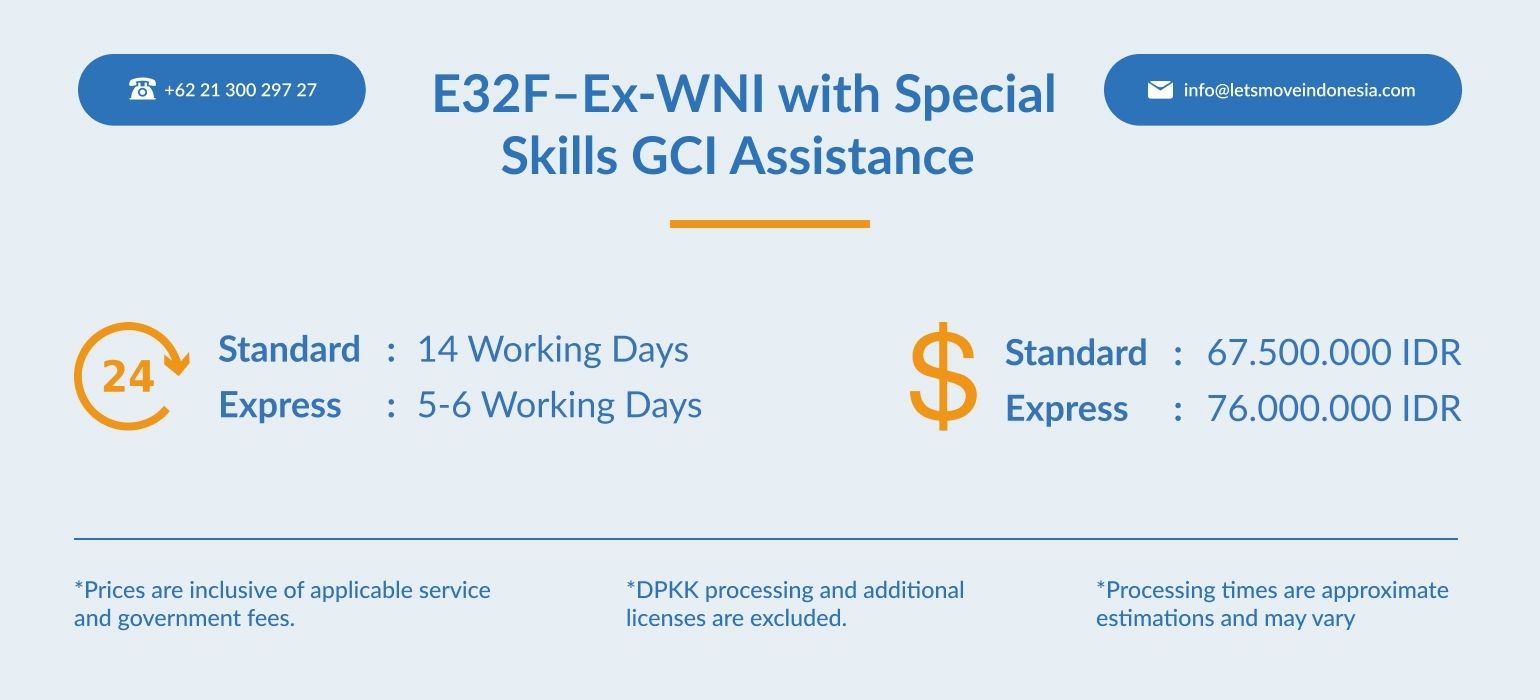
3. First- and Second-Degree Descendants of Ex-WNI (E32G)
For: Children and grandchildren of former Indonesian citizens.
Definition
Foreign nationals who are first-degree (children) or second-degree (grandchildren) descendants of former Indonesian citizens.
Stay Permit
- Unlimited Stay Permit
- Issued with 5-year plus validity (unlimited duration)
Permitted Activities
- Non-contractual work
- Free travel
- Tourism, family visits, cultural participation
Commitment Fulfillment
Descendants must meet higher financial commitments, divided by degree:
A. First-Degree Descendants (Children of Ex-WNI)
Minimum USD 25,000 in:
- Government bonds, OR
- Publicly listed shares, OR
- Mutual funds, OR
- Deposit in a state-owned bank, OR
- Property purchase (min. USD 250,000)
B. Second-Degree Descendants (Grandchildren of Ex-WNI)
Minimum USD 100,000 in:
- Government bonds, OR
- Publicly listed shares, OR
- Mutual funds, OR
- Deposit in a state-owned bank, OR
- Property purchase (min. USD 1,000,000)
Additional Requirements
- Proof of lineage (KK, marriage book, birth certificate, etc.)
- Proof of income:
- Min. USD 15,000 per year
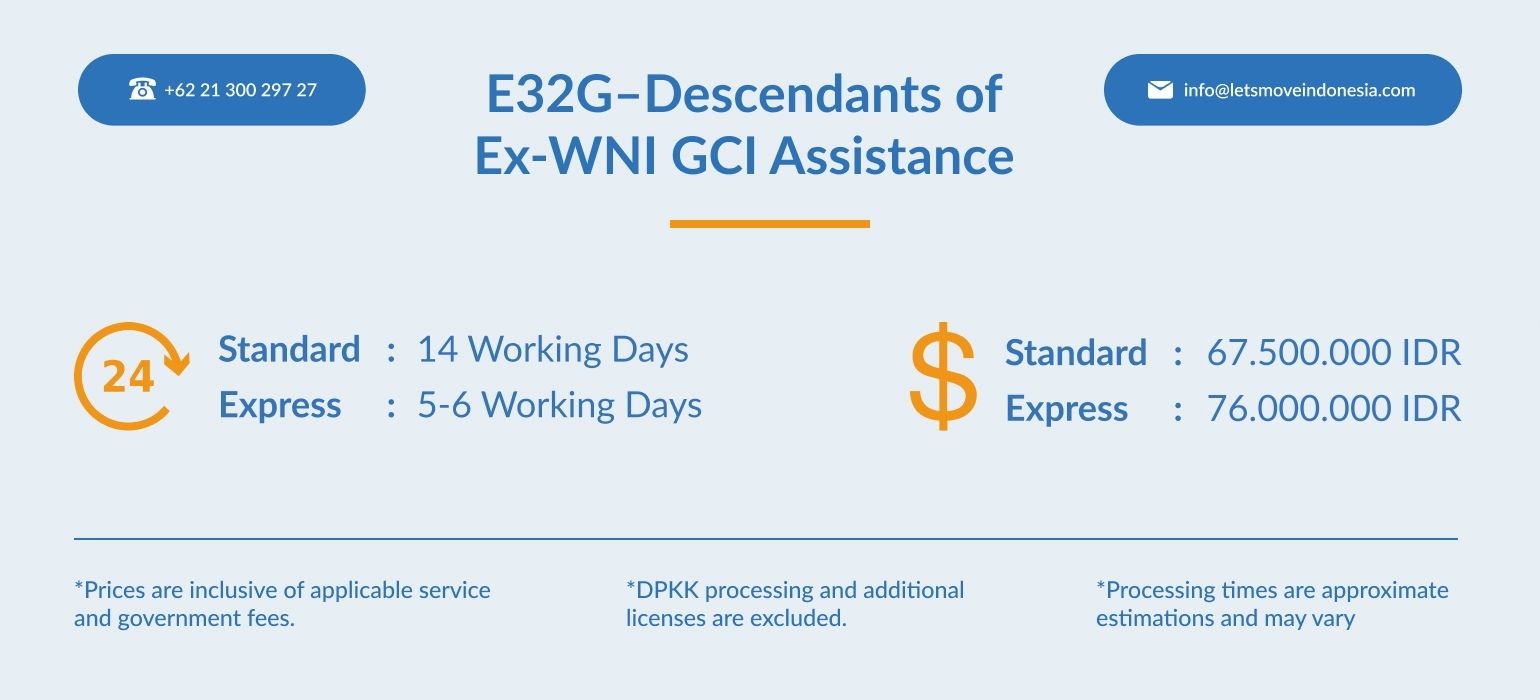
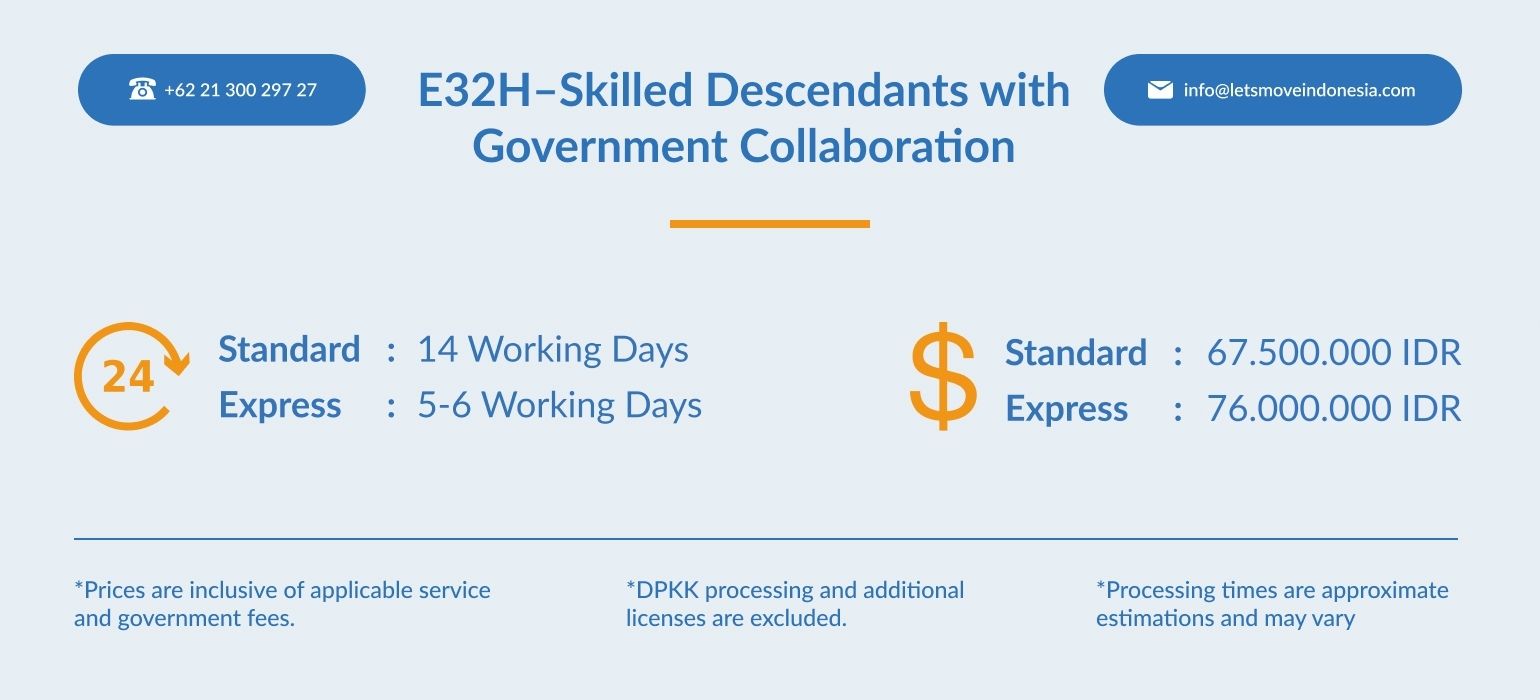
4. Descendants of Ex-WNI With Special Skills / Talents Collaborating With the Government (E32H)
For: First- or second-degree descendants of Ex-WNI who have special skills and intend to collaborate with the Indonesian Government.
Definition
This category is intended for descendants (up to second degree) of former Indonesian citizens who possess special expertise or talent, and who will collaborate with the Government of Indonesia while permanently staying in Indonesia.
Stay Permit
- Unlimited Stay Permit
- Issued with 5-year plus validity (unlimited duration)
What You Can Do
(Same as other categories)
- Conduct non-contractual work
- Bring eligible family members
- Free re-entry travel
- Conduct cultural, tourism, or family activities
What You Cannot Do
- Receive wages from Indonesian companies
- Sell goods/services in Indonesia
- Exercise political rights
Your Obligations
- Financial sufficiency
- Cultural and legal compliance
- Submit commitment proof within 90 days
- Maintain immigration compliance
Document Requirements
- Valid passport (min. 6 months)
- Proof of funds (min. USD 2,000)
- CV and photo
- Proof of Indonesian lineage (KTP, KK, marriage book, birth documents, etc.)
- Commitment fulfillment of at least USD 10,000 in government bonds, shares, mutual funds, deposits, or property
Key Benefits of GCI for Diaspora Families and Foreign Nationals
GCI provides a robust set of advantages:
1. Lifetime Residency (Unlimited Stay)
No more annual KITAS renewals or five-year KITAP reapplications.
2. No Citizenship Renunciation
Applicants can maintain their current nationality while reconnecting with Indonesia.
Kindly remember that you still have to renew your MERP once every 5 year.
3. Digital Application Through Indonesia’s Official Portal
Full online process from submission to granting.
4. Practical & Stability
No need to go through ITAS
5. Multi-Entry Travel Privileges
Travel freely in and out of Indonesia with a valid re-entry permit.
6. Direct Integration Into Indonesia’s Cultural and Social Landscape
GCI represents a more dignified, structured pathway for long-term residence.
Important Limitations: What GCI Does NOT Provide
GCI is not a citizenship pathway. It does not offer:
- Voting rights
- Land ownership rights for landed property
- Eligibility for political office
- Permission to receive wages from Indonesian companies
- Eligibility for roles is restricted to Indonesian citizens
The purpose of GCI is residency, not citizenship, ensuring Indonesia’s single nationality principle remains intact.
GCI vs KITAS vs KITAP: What Makes GCI Different?
| Permit Type | GCI | KITAS (ITAS) | KITAP (ITAP) |
| Expiry | Unlimited | 6–12 months | 5 years |
| Sponsor Required | No | Yes | Yes |
| Eligible for Foreigners with Indonesian Lineage | Yes | No | No |
| Renewal Needed | No | Yes | No |
| Citizenship Required | No | No | No |
How to Apply for Global Citizenship of Indonesia?
- Confirm eligibility category (E32E or E32G)
- Prepare required documents
- Fulfill financial commitments
- Apply through the e-Visa system, or trust Lets Move Indonesia to handle the process on your behalf.
- Undergo background checks
- Receive an unlimited stay permit electronically
- Optional physical card collection
Several Common Questions About Global Citizenship of Indonesia (GCI)
1. Can GCI holders own or buy property in Indonesia?
At this time, the Indonesian government has not released specific rules granting GCI holders new property ownership privileges. However, GCI holders may still purchase property under the existing foreign ownership framework, typically through the Right to Use (Hak Pakai) title on landed houses or apartments.
Further updates may be issued by the Ministry as the program is implemented.
2. Is there a PNBP (government fee) required to apply for GCI?
Yes. Each GCI category is subject to an official PNBP fee of IDR 34,800,000, as stated in the Ministry’s published regulations.
3. Can Global Citizenship Indonesia be used by foreign spouses of Indonesian citizens?
No. GCI is not designed for foreign spouses, unless the spouse also qualifies as a diaspora (Ex-WNI or descendant of Ex-WNI).
Foreign spouses generally remain eligible through the family-based ITAS/ITAP pathway, not GCI.
4. Can I convert my ITAP to a GCI Permit?
Yes. Based on current immigration practices, ITAP-to-GCI conversion is possible and is expected to follow a process similar to other stay permit conversions. Applicants may still require:
- EPO (Exit Permit Only)
- Adjustment of data in the immigration system
- Re-issuance of the new stay permit category
Further procedural details will be clarified as implementation progresses.
5. Do GCI holders need additional permits after approval?
Yes. Although the GCI provides an unlimited stay permit, holders must still maintain:
A valid Multiple Exit Re-Entry Permit (MERP), which must be renewed every 5 years.
Other auxiliary permits (such as work permits) are not applicable, since GCI holders are prohibited from receiving wages or engaging in contractual employment in Indonesia.
6. Can GCI holders work in Indonesia?
Not in contractual, paid employment. GCI holders may conduct activities related to personal or family needs, but they cannot:
- Receive wages from Indonesian individuals or companies
- Engage in commercial or business transactions as an employee
8. Does GCI lead to Indonesian citizenship?
No. GCI provides permanent residency, not nationality.
GCI represents one of Indonesia’s most significant immigration reforms, offering a structured pathway for diaspora members and descendants to reconnect with Indonesia without compromising citizenship.
It eliminates complex renewals, reinforces Indonesia’s commitment to global mobility, and provides a dignified, secure residency framework for the country’s extended global family.
9. I am a spouse of an ex-Indonesian citizen, can I apply for a GCI visa program?
At this stage, it is still unclear whether the GCI program directly accommodates spouses of diaspora applicants. Current regulations primarily focus on Ex-WNI and their biological descendants, and do not explicitly define a pathway for spouses without Indonesian lineage.
Because the policy is new and still developing, it’s best to consult with a professional immigration consultant to get the most accurate and up-to-date guidance for your situation.
Stay Updated With Lets Move Indonesia
As part of LMI Consultancy, Lets Move Indonesia is committed to providing accurate, professional, and comprehensive guidance on GCI, KITAS, KITAP, business visas, and all Indonesian residency pathways.
For personalised consultation, up-to-date requirements, or application assistance.