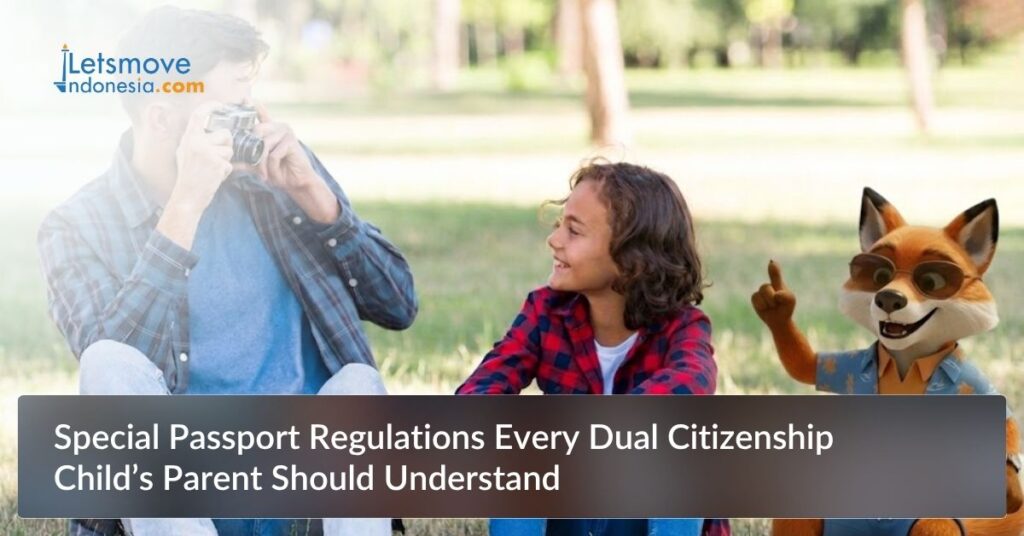
For many international families in Indonesia, dual citizenship offers flexibility, cultural connection, and broader opportunities for children growing up across borders. Yet behind that flexibility lies a legal framework that many parents only discover when applying for or renewing an Indonesian passport.
Under Indonesian nationality law, children with dual citizenship status are subject to specific immigration and citizenship rules that differ from standard passport procedures. In practice, this means that not every child above the age of 17 is automatically entitled to receive a full five- or ten-year Indonesian passport validity period.
According to the Directorate General of Immigration Indonesia, passport validity for dual citizenship children must align with the legal deadline for choosing a single nationality. For parents navigating mixed-nationality families, understanding these regulations early is essential to avoiding future administrative complications.
Understanding Dual Citizenship for Children in Indonesia
Indonesia generally does not recognise permanent dual citizenship for adults. However, under Law No. 12 of 2006 concerning Indonesian Citizenship, children born into certain international family situations may temporarily hold dual nationality status.
This commonly applies to:
- Children born from mixed marriages between Indonesian citizens and foreign nationals
- Children born in countries applying citizenship by birthright
- Children obtaining another nationality through parental citizenship
Under Article 6 paragraph (1) of the law, children with dual nationality are required to formally choose one citizenship after reaching the age of 18 or upon marriage.
More importantly, Article 6 paragraph (3) establishes a strict deadline:
- The citizenship decision must be declared no later than three years after turning 18 years old or after marriage.
In practical terms, this means dual citizenship status can only remain valid until the child reaches the age of 21, unless citizenship selection is completed earlier.
Why Passport Validity Becomes Limited
One of the most misunderstood aspects of Indonesia’s dual citizenship framework concerns passport duration.
According to Achmad Nur Saleh, Coordinator of Public Communication Functions at the Directorate General of Immigration, Indonesian passports issued to dual citizenship children cannot exceed the legal age limit for citizenship selection.
Example Scenario
If a child with dual citizenship applies for an Indonesian passport at age 18 but has not yet formally selected Indonesian citizenship, the passport validity can only extend until the child turns 21.
| Applicant Age | Maximum Passport Validity |
| 18 years old | 3 years |
| 19 years old | 2 years |
| 20 years old | 1 year |
Even though regular Indonesian passports may normally be issued for five or ten years, these limitations apply specifically to children with dual citizenship status.
The purpose of this restriction is to ensure compliance with Indonesian nationality law and prevent documentation conflicts once the citizenship selection deadline is reached.
Registration Requirements for Dual Citizenship Children
Parents of dual citizenship children are required to complete administrative registration before the child reaches 18 years old.
Without this registration, future immigration applications may become significantly more complicated.
Required Documents for Indonesian Passport Applications
When applying for an Indonesian passport for a dual citizenship child, parents generally need to prepare:
- e-KTP of the Indonesian parent
- Family Card (Kartu Keluarga)
- Child’s birth certificate
- Marriage certificate or marriage book
- Valid immigration stay permit of the foreign parent (if applicable)
- Copy of the foreign parent’s passport
Immigration authorities may also request additional supporting documents depending on the individual case and nationality status involved.
Why Early Preparation Matters
For international families, immigration compliance often becomes more complex as children approach adulthood.
Failing to understand citizenship deadlines may result in:
- Restricted passport validity
- Delays in immigration processing
- Administrative issues with residency documentation
- Difficulties travelling internationally
- Citizenship status uncertainty
Parents are therefore strongly encouraged to proactively monitor timelines and prepare citizenship declarations well before the legal deadline arrives.
As Indonesian immigration authorities continue modernising immigration administration, documentation consistency and legal clarity are becoming increasingly important.
Dependent Visa for Children (Index E31)
For foreign families living in Indonesia, children may also reside legally under Indonesia’s dependent visa framework.
Dependent visas under Index E categories are commonly linked to:
- Work KITAS holders
- Investor KITAS holders
- Spouse-sponsored KITAS holders
- KITAP holders
These visas allow children to legally stay in Indonesia while accompanying parents who hold valid residency permits.
Common Dependent Visa Categories Include:
| Visa Index | Description |
| E31C | Child with one Indonesian parent |
| E31E | Child under 18 years old of KITAS/KITAP holder |
| E31F | Adopted child of Indonesian citizen |
For many expatriate families, these visa categories become essential long-term residency solutions while children maintain dual citizenship status.
Introducing Global Citizenship Indonesia (GCI)
As global mobility continues increasing, many international families seek broader guidance beyond immigration procedures alone.
Global Citizenship Indonesia (GCI) supports internationally connected individuals and families navigating citizenship, residency, and cross-border legal frameworks in Indonesia.
Services may include:
- Dual citizenship consultation
- Residency planning
- Family immigration strategy
- Long-term relocation support
- International documentation assistance
For parents managing mixed-nationality family structures, understanding both citizenship law and immigration compliance is becoming increasingly essential in today’s interconnected world.
Process Your Visa with Lets Move Indonesia
Whether applying for a dependent visa, extending a family KITAS, or navigating dual citizenship documentation, working with experienced professionals can help simplify the process considerably.
At Lets Move Indonesia, we assist expatriates, investors, and international families with end-to-end immigration solutions tailored to Indonesia’s evolving legal framework.
Our services include:
- Family and dependent visa processing
- KITAS and KITAP applications
- Visa extensions and renewals
- Immigration consultation for mixed-nationality families
- Passport and residency documentation assistance
With immigration regulations continuing to evolve, obtaining accurate guidance early can help families avoid unnecessary complications later, particularly when managing citizenship matters involving children.