Indonesia enters 2026 with renewed confidence and structural momentum. Macroeconomic stability, strong liquidity support, and continued reform efforts have positioned the country as one of Southeast Asia’s most compelling long-term investment destinations.
At the same time, the regulatory and compliance environment for foreign investors has become more sophisticated, requiring careful planning across company incorporation, immigration, taxation, and ongoing operational compliance.
This article provides a comprehensive overview of Indonesia’s 2026 investment outlook, followed by a practical roadmap for investing through a PT PMA (foreign-owned company). It also explains why aligning with a reliable, on-the-ground consultant is no longer optional for foreign businesses seeking sustainable growth. The article concludes by outlining how Lets Move Indonesia, a subsidiary of LMI Consultancy, supports investors throughout their Indonesia journey.
Indonesia Investment Outlook for 2026: Potential Sectors and Investment Climate
Indonesia’s macroeconomic narrative entering 2026 is notably confident. According to Bank Indonesia, the country’s central bank, policy measures implemented over the past year are now translating into measurable financial stability and lending capacity.
Speaking in Jakarta on 1 December 2025, Senior Deputy Governor Destry Damayanti highlighted that government liquidity support had significantly strengthened Indonesia’s banking system. She noted that while supply-side stability has largely been addressed, the next phase of growth depends on private-sector investment and execution.
To support this, the government deposited IDR 276 trillion into the banking sector, creating substantial liquidity buffers aimed at lowering lending rates and expanding access to capital. The message to investors is clear: capital is available, and Indonesia is actively encouraging businesses to deploy it productively.
10 Potential Industries to look up to in 2026
Indonesia continues to be one of Southeast Asia’s most dynamic economies. Growth is driven by strong domestic demand, digital adoption, infrastructure development, and government-backed reforms. Sectors such as e-commerce, manufacturing, tourism, and renewable energy are expanding rapidly to create concrete opportunities for businesses and investors.
Below are the 10 fastest-growing industries in Indonesia and why they matter.
1. E-commerce
Indonesia’s e-commerce market is growing at scale and is projected to reach USD 160 billion by 2030. This growth is driven by rising internet penetration, a young digital-native population, and widespread adoption of digital payments.
Online shopping has become a mainstream consumer behavior, making e-commerce one of the most attractive sectors for both local and foreign businesses.
2. Travel and Tourism
Indonesia’s tourism sector is recovering strongly following the pandemic. International arrivals are increasing, with Bali remaining a key destination, while other regions continue to develop.
Tourism contributes close to 5% of Indonesia’s GDP and is expected to generate more than 5 million jobs by 2033, creating long-term opportunities across hospitality, transportation, and services.
3. Infrastructure and Construction
Indonesia has made infrastructure a long-term national priority. Between 2020 and 2024, over USD 400 billion was allocated to roads, ports, airports, and urban development projects.
The construction sector contributes nearly 10% of GDP, supporting growth in logistics, real estate, and industrial development.
4. Manufacturing
Manufacturing remains the backbone of Indonesia’s economy, contributing 18.67% of GDP in 2023. Key segments include food and beverages, automotive, electronics, and textiles.
The sector provides millions of jobs and continues to benefit from industrial downstreaming and export-oriented policies.
5. Mining and Downstream Processing
Indonesia is one of the world’s richest countries in natural resources, including coal, nickel, and gold. Mining contributes approximately 10.5% of GDP.
Recent policies emphasize downstream processing, such as EV battery production, allowing Indonesia to move up the global value chain rather than exporting raw materials.
6. Agriculture and Fisheries
Agriculture and fisheries contribute over 12% of GDP and remain critical to food security and exports. Indonesia’s vast farmland and marine resources create strong potential for agribusiness and aquaculture.
Innovation and investment in this sector could significantly boost productivity and export competitiveness.
7. Renewable Energy and Waste Management
Indonesia is expanding renewable energy capacity, including solar, geothermal, and hydropower. Government policies are encouraging sustainable energy and improved waste management.
As environmental standards rise, this sector is attracting both domestic and foreign investment focused on long-term sustainability.
8. Healthcare and Pharmaceuticals
Indonesia’s healthcare sector is growing alongside universal healthcare expansion and rising demand for quality medical services.
Telemedicine, pharmaceutical manufacturing, and healthcare infrastructure are key growth areas, particularly as access improves outside major cities.
9. Education Technology (EdTech)
Indonesia’s young population is driving rapid adoption of online learning and digital training platforms. EdTech supports workforce upskilling, vocational training, and flexible education models.
Companies such as Mekari and initiatives like Mekari University reflect how digital education is becoming embedded in professional development.
10. Halal Industry
As the world’s largest Muslim-majority country, Indonesia plays a major role in the global halal economy. Demand continues to rise for halal food, cosmetics, pharmaceuticals, and financial services.
With strong domestic consumption and increasing exports, the halal industry is positioned for sustained long-term growth.
Economic Growth Projections and Global Positioning
The Indonesian government projects economic growth exceeding 5.4% in 2026, supported by easing global pressures and improving domestic fundamentals. Coordinating Minister for Economic Affairs Airlangga Hartarto emphasized that Indonesia has grown 35% over the past seven years, despite facing global uncertainty, trade disruptions, and geopolitical shocks.
Importantly for foreign investors, many of the global headwinds experienced throughout 2025, such as trade tensions and supply chain realignments, are now considered manageable and largely priced in. Consumer confidence remains solid, manufacturing activity continues to expand, and financial markets have shown resilience. Inflation and exchange rate movements also remain within safe and predictable ranges.
From an international perspective, Indonesia is strengthening its global economic integration through:
- Tariff discussions with the United States
- Progress toward CPTPP accession
- Engagement with BRICS+ economies
- Continued steps toward OECD membership
These initiatives reinforce Indonesia’s positioning as a rules-aligned, globally connected investment destination rather than a purely domestic market play.
Investment Realisation and Policy Direction
Investment momentum remains strong. Investment realisation has already surpassed IDR 1,400 trillion, with a year-end target of IDR 1,900 trillion. This reflects sustained investor confidence across manufacturing, downstream industries, infrastructure, and digital services.
Domestically, the government is accelerating:
- Structural economic reforms
- Licensing certainty and administrative clarity
- Digital transformation through initiatives such as DEFA
- Local currency transaction frameworks
- Cross-border QRIS integration
These reforms signal a shift toward greater transparency, digitalisation, and enforceability, beneficial for serious investors, but challenging for those entering without proper guidance.
Roadmap to Invest in Indonesia
While Indonesia’s outlook is positive, successful market entry depends on execution. Below is a practical roadmap for foreign investors planning to establish operations in Indonesia.
1. Establishing a Legal Presence: PT PMA Company Registration
A PT PMA (Perseroan Terbatas Penanaman Modal Asing) is the legally recognised structure for foreign-owned businesses operating in Indonesia.
Key elements of PT PMA setup include:
Shareholder and director composition
- Minimum capital requirements aligned with business classification
- Correct KBLI (business activity) selection
- OSS-based licensing and post-incorporation reporting
A properly structured PT PMA allows companies to:
- Conduct revenue-generating activities
- Open corporate bank accounts
- Hire local and foreign employees
- Enter into enforceable contracts
Conversely, improper setup can restrict operations, delay licensing, and create compliance risks that are costly to correct later.
Read more about Company Registration: Guide to Register a Company in Indonesia
2. Immigration & Visa Compliance for Foreign Investors
Immigration compliance has become an increasingly active enforcement area. Foreign investors and executives must ensure that their visa status aligns with their actual activities in Indonesia.
Common requirements include:
- Investor visas
- Work-related stay permits
- Long-term residency options
Risks arise when an individual performs business activities under an inappropriate visa type. Business actors should also pay attention to the triggered tax obligations from the long residency period; therefore, it’s mandatory to ensure your visa and corporate roles are misaligned.
Read more about Indonesia Visa: Answering Common Questions About Indonesia Visas
3. Tax and Reporting Obligations
Tax compliance operates in parallel with immigration and corporate obligations.
Corporate tax considerations include:
- Monthly and annual tax filings
- Withholding tax responsibilities
- Transfer pricing exposure
Individual tax considerations for foreigners include:
- Tax residency determination
- Personal income tax obligations
- Risk of dual non-compliance (tax vs immigration)
A common issue for foreign businesses is complying with one framework while unintentionally violating another. Alignment across systems is essential.
Read more about Corporate Annual Tax Return (SPT) Filing in Indonesia: Due Date, Steps, Requirements
Post-Incorporation Compliance: Maintaining authority of the company
Many investors focus heavily on incorporation but underestimate what follows. In practice, most enforcement actions occur after setup, not during registration.
Ongoing obligations may include:
- License renewals and activity reporting
- Employment and payroll compliance
- Sector-specific regulations
- Digital and data-related compliance
Sustainable operations in Indonesia require continuous monitoring, not one-off compliance.
Why Partnering with a Reliable Consultant Matters
Indonesia’s regulatory environment is characterised by the presence of multiple supervisory authorities, evolving interpretations of regulations, and regional administrative differences. These factors create a complex compliance landscape that can be difficult to navigate, particularly for foreign businesses unfamiliar with local practices.
Attempting to manage this environment independently often results in delays, penalties, or costly restructuring. In many cases, the financial and operational impact of these issues far exceeds the cost of engaging professional advisory support from the outset.
A reliable consultant provides regulatory clarity, mitigates compliance risks, and ensures strategic alignment across legal, immigration, and tax frameworks. In an environment where capital is readily available and enforcement is increasingly active, the quality of execution becomes a clear competitive advantage.

Navigate Foreign Investment in Indonesia with Confidence in 2026
Indonesia’s 2026 investment outlook is underpinned by liquidity support, macroeconomic stability, and structural reform. The opportunity is real, but so is the complexity.
Foreign investors who succeed in Indonesia are those who plan early, structure correctly, and treat compliance as a strategic function rather than an administrative afterthought. With the right partner, Indonesia offers not only growth but also durability.
Lets Move Indonesia: Your partner to set up a foreign direct investment across Indonesia
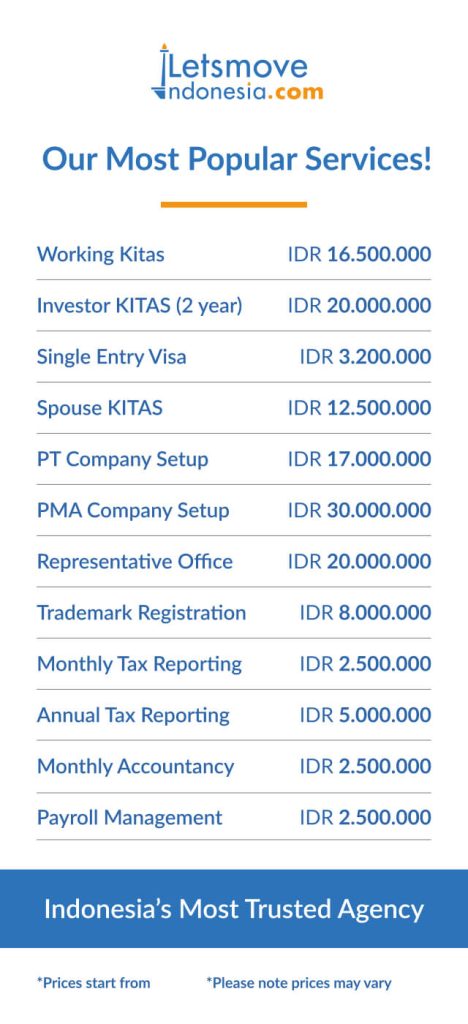
As a subsidiary of LMI Consultancy, we support foreign investors across the full lifecycle of doing business in Indonesia.
Our local partner and consultation services include:
- PT PMA incorporation and licensing
- Investor and executive visa solutions
- Corporate and individual tax coordination
- Ongoing compliance and advisory support
We approach practically and are fully aligned with Indonesia’s regulatory framework, ensuring that every decision is compliant from the outset. We focus on building structures designed for long-term operations rather than short-term fixes, allowing businesses to scale sustainably as regulations and market conditions evolve.
At Lets Move Indonesia, our services are tailored specifically for founders, investors, and regional headquarters that require clarity, consistency, and strategic foresight when operating in Indonesia.
Considering investing in Indonesia in 2026? Partner with Lets Move Indonesia to enter the market with clarity, confidence, and long-term compliance.