Halal Certification – Who is it for and what are the benefits
Approximately 88% of the people living in Indonesia are Muslim. This implies that the country places first regarding the highest proportion of Muslim individuals across the globe. Therefore, investors seeking to enter this country’s market should pay special concern to obtaining halal certification.
If you are planning to sell food products and edible products in Indonesia, Halal certification is one of the essential licenses you should never miss to obtain consumer trust.
Halal food is addressed to all products and services that have proven not to contain prohibited materials, ingredients, or unlawful methods according to Sharia Law.
Halal certification in Indonesia caters to a declaration to prove that the products ingredients comply with Islamic law as Indonesian Ulema Council (MUI) and serve as the Islam justification for Muslim citizens if certain products or services are permissible to consume or use. The food must undergo a pharmaceutical audit to ensure it meets government regulation halal standards and is free from additives.
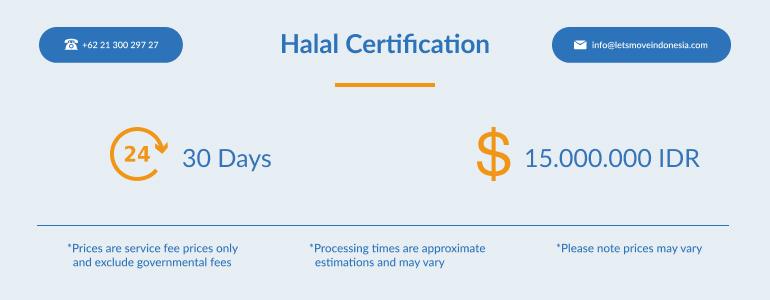
The process of issuing a Halal Certification will take approximately 21 days and a lot of required steps to do. Therefore, acquiring your Halal Certificate with Lets Move Indonesia ensures you save time and hassle while still having your certificate issued on time.
Frequently Asked Questions
What are the commodities that require Halal certification?
The commodities are mostly consumable goods, such as foods, beverages and in some cases cosmetics.
How long a Halal certification in Indonesia is valid and can it be renewed?
Halal Certificate has no validity, as long as the product does not change ingredients, and it already has halal certification, then it can exist indefinitely.
Should I issue Halal Certifications to distribute and sell foreign products in Indonesia?
Should I issue Halal Certifications to distribute and sell foreign products in Indonesia?
What is the name of the institution/body that issues the halal compliance?
In Indonesia, the institution responsible for certifying Halal compliance is the Badan Penyelenggara Jaminan Produk Halal (BPJPH), or the Halal Product Assurance Organizing Agency.
The BPJPH is a government body under the Ministry of Religious Affairs that oversees and regulates the Halal certification process in Indonesia.
They work in conjunction with the Lembaga Pemeriksa Halal (LPH), or Halal Inspection Agencies, which conduct the actual inspections and audits of products and processes to ensure compliance with Halal standards.
Finally, the Majelis Ulama Indonesia (MUI), or the Indonesian Council of Ulema, plays a crucial role in issuing Halal fatwas or religious opinions on the Halal status of products based on the findings of the LPH.
Therefore, while the BPJPH issues the final Halal certificate, it relies on the collaboration with LPH and MUI to ensure the integrity and credibility of the certification process.
Given that Indonesia is the world's largest halal market, how has the issuance of halal certification in Jakarta specifically impacted various sectors in the Republic of Indonesia?
The issuance of halal certification in Jakarta has had a profound impact on various sectors across Indonesia, particularly in the food and beverage, cosmetics, and pharmaceutical industries. It has boosted consumer confidence, increased market access for businesses, and solidified Indonesia’s position as a global halal hub.
Does small business need Halal Certification?
Depends on your business needs. Essentially, Halal certification will be needed when your product enters the retail market.
How long does Indonesia's Halal Certification process take time?
The time it takes to get Halal certification can vary widely. Factors like how complex your business is, how prepared your paperwork is, and which certification body you choose all play a role. Simple businesses with everything ready can get certified faster, while bigger companies with more complex processes might take longer.
Generally, you can expect the process to include an application review (a few weeks), an on-site audit (a few days to weeks), and then the final decision and certification (a few more weeks). In total, this can take anywhere from a few weeks to several months. Being prepared, choosing the right certification body, and being quick to fix any issues can help speed things up.
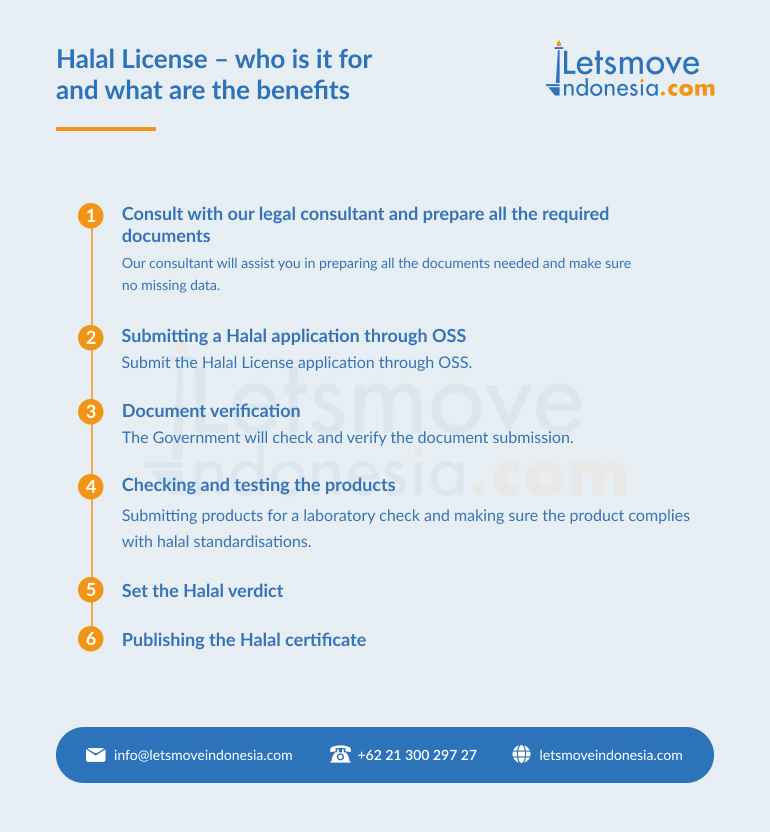
Steps to get your Halal Licenses with Lets Move Indonesia
Consult with our legal consultant and prepare all the required documents
Our consultant will assist you in preparing all the documents needed and make sure no missing data
Submitting a Halal Application through OSS
Submit the Halal License application through OSS
Document Verification
The Government will check and verify the document submission
Checking and Testing the Products
Submitting products for a laboratory check and making sure the product complies with halal standardisations.
Set the Halal Verdict
Publishing the Halal Certificate
Requirements
To apply for a Halal Certificate, an applicant should provide these requirements:
Personal data: NIB, if you do not have NIB, it can be proven by other licences (NPWP, SIUP, IUMK, IUI, etc.
Name and type of product
List of products and raw materials
Product processing process documentation
Halal Product Assurance system document
Other Popular Legal Licensing Services in Indonesia
Recognised as the Most Ethical Visa & Business Consultancy, Lets Move Indonesia has been the leading business consulting firm in Indonesia since 2016. We aim to be a complete resource for expatriates, giving reliable and professional assistance.
Indonesia has confirmed that the next phase of mandatory halal certification (sertifikasi halal) will proceed from 18 October 2026, with the government preparing specific arrangements for certain businesses and product categories. The Halal Product Assurance Organising Agency (BPJPH) confirmed on 9 October 2026 that the implementation date would not be postponed, while indicating that the […]
A virtual office in Indonesia offers businesses a flexible way to establish a professional business address without leasing a conventional office. For foreign investors and companies entering the Indonesian market, virtual office solutions can reduce overheads, provide administrative support and help establish a business presence, subject to applicable regulations. However, not every business activity is […]
Indonesia and Egypt have announced new bilateral agreements covering diplomatic cooperation, visa arrangements, statistics, and maritime affairs, alongside plans to expand trade and investment. The developments could strengthen economic ties between the two countries, although the implications for Immigration Indonesia and Indonesia Visa requirements will depend on how the agreements are implemented. Indonesian President Prabowo […]
For foreign investors looking to expand into Indonesia, acquiring an established business can offer a faster route into the market than building a new operation from the ground up. An acquisition can provide access to existing customers, local expertise, operational infrastructure and distribution networks, while helping an investor establish a stronger position in Southeast Asia. […]
After years of helping our clients settle in, build businesses and make Indonesia home, we wanted to do something in return. As a thank you to our loyal customers, every eligible service purchased from LMI Consultancy/Lets Move Indonesia comes with two complimentary tickets to selected Social Expat events in Jakarta and Bali, with a combined […]
With 2027 approaching, companies operating in Indonesia should begin planning around the official public holidays and collective leave days in the country. On 15 September 2026, the Government of Indonesia formally established the 2027 holiday calendar through the Joint Decree of the Minister of Religious Affairs, Minister of Manpower, and Minister of Administrative and Bureaucratic […]