For many foreigners looking to relocate to Indonesia, choosing the right long-term visa can be confusing. Questions frequently arise around the differences between the Second Home Visa, Golden Visa, Investor KITAS, and the increasingly discussed concept of a “Remote Worker Visa.”
Are the Second Home Visa and Golden Visa the same? Is the Second Home Visa designed for digital nomads? Can it lead to permanent residency in Indonesia? The answer is that each visa serves a different purpose.
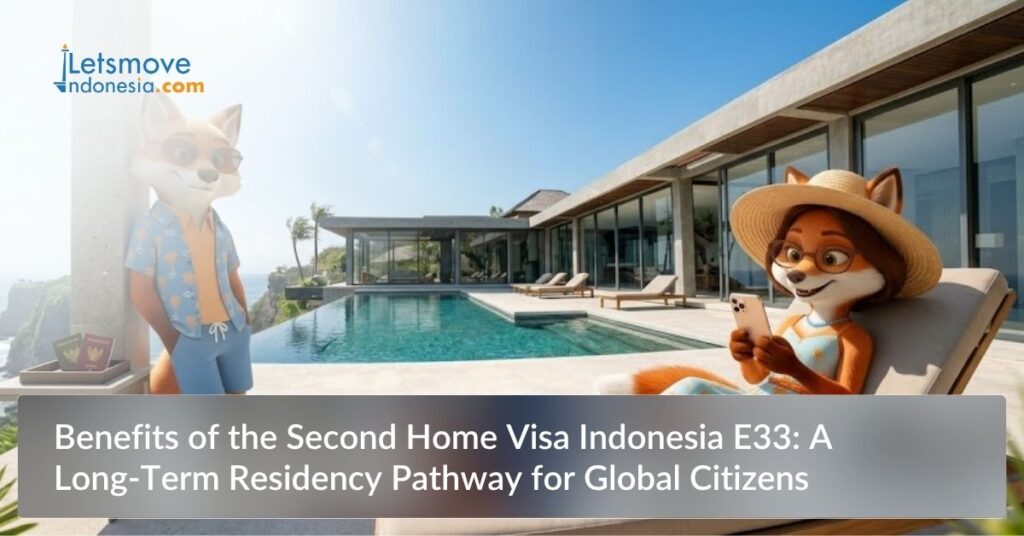
Indonesia’s Second Home Visa E33 is specifically designed for financially independent foreign nationals who wish to reside in Indonesia long-term without engaging in local employment. Unlike many other residence permits that require regular renewals, the Second Home Visa offers one of the longest stay periods currently available under Indonesian immigration regulations.
Whether you are planning to retire in Bali, relocate your family, manage international investments, or establish a long-term base in Indonesia, the Second Home Visa may offer an attractive solution.
Second Home Visa Indonesia E33: What Is It?
The Second Home Visa E33 is a limited stay permit that allows eligible foreign nationals to live in Indonesia for an extended period while maintaining financial independence.
The programme was introduced as part of Indonesia’s efforts to attract global talent, investors, retirees, and high-net-worth individuals seeking long-term residency options.
Unlike employment-based visas, the Second Home Visa is not linked to an Indonesian employer, sponsorship by a company, or local employment activities.
Key Features
| Category | Details |
| Visa Type | Limited Stay Visa (E33) |
| Validity | Up to 5 or 10 years |
| Multiple Entry | Yes |
| Local Employment | Not permitted |
| Family Sponsorship | Available |
| Investment Activities | Permitted |
| Pathway to ITAP | Possible |
The visa offers a practical solution for foreigners who wish to establish a presence in Indonesia while maintaining flexibility and long-term security.
Is the Second Home Visa the Same as the Golden Visa?
No.
Although both programmes target affluent foreigners, they serve different purposes and have different qualification requirements.
Second Home Visa vs Golden Visa
| Feature | Second Home Visa | Golden Visa |
| Main Purpose | Long-term residence | Investment-based residency |
| Investment Requirement | Proof of funds or qualifying assets | Significant investment commitment |
| Work Rights | No | Depends on category |
| Validity | Up to 10 years | Up to 10 years |
| Family Sponsorship | Yes | Yes |
| Suitable For | Retirees, remote income earners, families | Investors and business leaders |
The Second Home Visa focuses primarily on residency, while the Golden Visa is intended to attract strategic investors and business professionals contributing to Indonesia’s economy.
Is the Second Home Visa the Same as a Remote Worker Visa?
Not exactly.
Indonesia currently does not have a standalone visa category officially called a “Remote Worker Visa.”
However, many international professionals compare the Second Home Visa to remote worker programmes available in other countries because it allows financially independent individuals to reside in Indonesia without seeking local employment.
The crucial distinction is that the visa holder must comply with Indonesian immigration regulations and cannot undertake unauthorised employment activities within Indonesia.
5 Key Benefits of the Second Home Visa Indonesia
1. Moving to Indonesia for Up to 10 Years
One of the most attractive advantages of the Second Home Visa is its extended validity period.
Unlike many KITAS categories that require renewal every one or two years, eligible applicants may obtain residency for up to ten years.
Why This Matters
- Fewer immigration renewals
- Reduced administrative burden
- Greater long-term certainty
- Stable residency planning
- Ideal for retirement and relocation
- Can open an Indonesian Bank Account
For many expatriates relocating to Bali, Jakarta, Lombok, or other parts of Indonesia, this provides significantly greater convenience compared to traditional residence permits.
2. Long-Term Visas for Family Members
Relocating internationally often involves more than one person.
The Second Home Visa allows immediate family members to obtain long-term stay permits under the principal applicant’s residency arrangement.
Eligible Family Members
- Spouse
- Children
- Parents (subject to applicable requirements)
This makes the programme particularly attractive for families seeking to establish a long-term lifestyle in Indonesia.
Whether enrolling children in international schools or caring for ageing parents, the visa offers greater flexibility for family relocation.
3. Minimal Documentation Requirements
Compared to certain investment-based immigration programmes globally, the Second Home Visa offers a relatively straightforward qualification pathway.
Applicants are generally required to demonstrate the availability of qualifying funds or assets.
Typical Financial Evidence
| Requirement Type | Example |
| Bank Deposit | Qualifying funds held in an approved account |
| Property Ownership | Certain qualifying real estate holdings |
| Asset Verification | Supporting financial documentation |
Unlike investor visas, applicants are not required to establish a PT PMA, employ staff, or actively operate a business.
This simplicity appeals to retirees, entrepreneurs, and globally mobile individuals seeking a residence solution without extensive business obligations.
4. Potential Pathway to Permanent Residency
Another significant benefit is the possibility of obtaining ITAP (Permanent Stay Permit) after meeting applicable residency requirements.
What is ITAP? Convert ITAS to ITAP
ITAP (Izin Tinggal Tetap) is Indonesia’s equivalent of permanent residency.
Benefits may include:
- Long-term legal residency
- Reduced renewal requirements
- Enhanced immigration stability
- Greater administrative convenience
Under current regulations, eligible foreigners who have maintained legal residence may become eligible to apply for permanent residency after several years.
The ITAP itself generally requires renewal only every five years.
For those intending to build a long-term future in Indonesia, this creates an attractive pathway beyond temporary residence permits.
5. Business and Investment Opportunities
Although the Second Home Visa does not function as a work permit, it still offers substantial flexibility for wealth management and investment activities.
Permitted Activities May Include
- Purchasing shares in Indonesian companies
- Holding investments
- Acquiring qualifying property interests
- Managing international businesses
- Exploring future investment opportunities
Important Reminder
The Second Home Visa does not authorise:
- Local employment
- Receiving Indonesian salary income
- Working for Indonesian companies without appropriate permits
Foreign nationals intending to work in Indonesia should instead explore options such as a Working KITAS or Investor KITAS.
Frequently Asked Questions
Can Second Home Visa Holders Sponsor Their Spouse and Family?
Yes. Eligible family members may apply for residency permits connected to the principal visa holder, subject to prevailing immigration requirements.
This makes the programme particularly suitable for families relocating to Indonesia together.
Can I Work Using a Second Home Visa?
No. The Second Home Visa is designed for residency purposes rather than employment.
Foreign nationals intending to work in Indonesia must obtain the appropriate work authorisation and immigration permits.
Can I Invest in Indonesia Using a Second Home Visa?
Yes. While the visa does not function as a work permit, holders may undertake certain investment-related activities, including share ownership and other qualifying investments.
For active business operations, additional licences and immigration arrangements may be required.
Apply for a Second Home Visa: Requirements and Application Process
Although requirements may evolve, applicants generally need to prepare:
Personal Documents
- Valid passport
- Recent photograph
- Curriculum vitae
- Immigration application forms
Financial Documentation
- Proof of qualifying funds
- Asset verification documents
- Supporting financial statements
Additional Supporting Documents
- Family relationship documents (if applicable)
- Immigration declarations
- Compliance documentation
Each application is assessed individually by Indonesian Immigration.
Obtain a Second Home Visa with Lets Move Indonesia
E33 visa offers a unique opportunity for globally mobile individuals seeking long-term residency in one of Southeast Asia’s most dynamic destinations.
Whether you are planning to retire in Bali, relocating your family, maintaining regional investments, or exploring a pathway to permanent residency, selecting the right immigration strategy is essential.
At Lets Move Indonesia, our immigration specialists assist clients with:
- Second Home Visa applications
- Family visa arrangements
- Long-term residency planning
- Immigration compliance assessments
- Investor KITAS consultations
- Golden Visa advisory services
- Permanent residency (ITAP) guidance
With extensive experience supporting expatriates, investors, retirees, and international families, we help simplify the application process while ensuring full compliance with Indonesian immigration regulations.