For any business operating in Indonesia, legal identity begins with a single number. The Nomor Induk Berusaha, or NIB, serves as the foundational registration credential for all business entities in the country, and knowing how to verify one is an essential skill for investors, partners, and entrepreneurs alike.
What is a Business Registration Number?
The NIB (Nomor Induk Berusaha) is a 13-digit unique identifier assigned to every registered business entity in Indonesia. You’ll first encounter your this number when you incorporate your business through the relevant company registry, as this unique identifier appears on your certificate of incorporation and all official company documents.
It is issued through the Online Single Submission (OSS) system, administered under the Ministry of Investment and the Investment Coordinating Board (BKPM). The NIB was introduced under Government Regulation No. 24 of 2018 on Electronically Integrated Business Licensing Services, and further reinforced through Presidential Regulation No. 91 of 2017.
Before its introduction, businesses were required to obtain multiple separate licences, including the TDP (Company Registration Certificate), SIUP (Trading Business Licence), and IUP, each through different processes and agencies. The NIB consolidated all of these into a single registration number, significantly simplifying the licensing landscape.
Today, the company registration number also functions simultaneously as a company’s Import Identification Number (Angka Pengenal Impor/API), Company Registration Certificate (TDP), and Customs Access Right, making it one of the most functionally dense business credentials in the Indonesian regulatory framework.
For micro, small, and medium enterprises (MSMEs) operating in low-risk sectors, the NIB carries an additional function: it serves as the business’s Indonesian National Standard (SNI) compliance marker and as an official halal assurance declaration issued on behalf of the government.
Also Read: What is NIB? Why Business Identification Number Essential for PT PMAs
Importance of the NIB for Company Registration and Business Operations
The NIB is not merely a formality, it is the legal backbone of any business activity in Indonesia. Without it, a company cannot legitimately operate, access financial services, or participate in government procurement processes. Here is why holding a valid NIB matters:
It acts as the primary gateway to all subsequent licensing. Any additional permits or sector-specific licences a business may require, from operational licences to environmental approvals, can only be pursued once the NIB is in place. It also must be referenced in other critical registration documents, including BPJS Ketenagakerjaan (employment insurance) enrolment and trading licence applications.
Beyond compliance, the NIB opens access to a range of institutional facilities. These include business financing from banking institutions, eligibility for government-organised training programmes, and the ability to register as a supplier or contractor for government goods and services procurement. In short, the NIB positions a business to participate fully in both the private and public economic ecosystem.
The OSS system’s automatic approval mechanism also means that once all required information and documents are correctly submitted, the NIB can be issued faster than most business owners expect, removing the weeks or months of waiting that characterised the old multi-licence process.
How to Confirm a Company Registration Number Status in Indonesia
Once a business has registered through the OSS system and obtained its NIB, it is equally important to verify that the number is properly recorded and recognised by the relevant authorities. This verification step protects businesses and their partners from dealing with unregistered or fraudulent entities. There are two official online platforms through which an NIB check can be conducted.
The INSW Portal
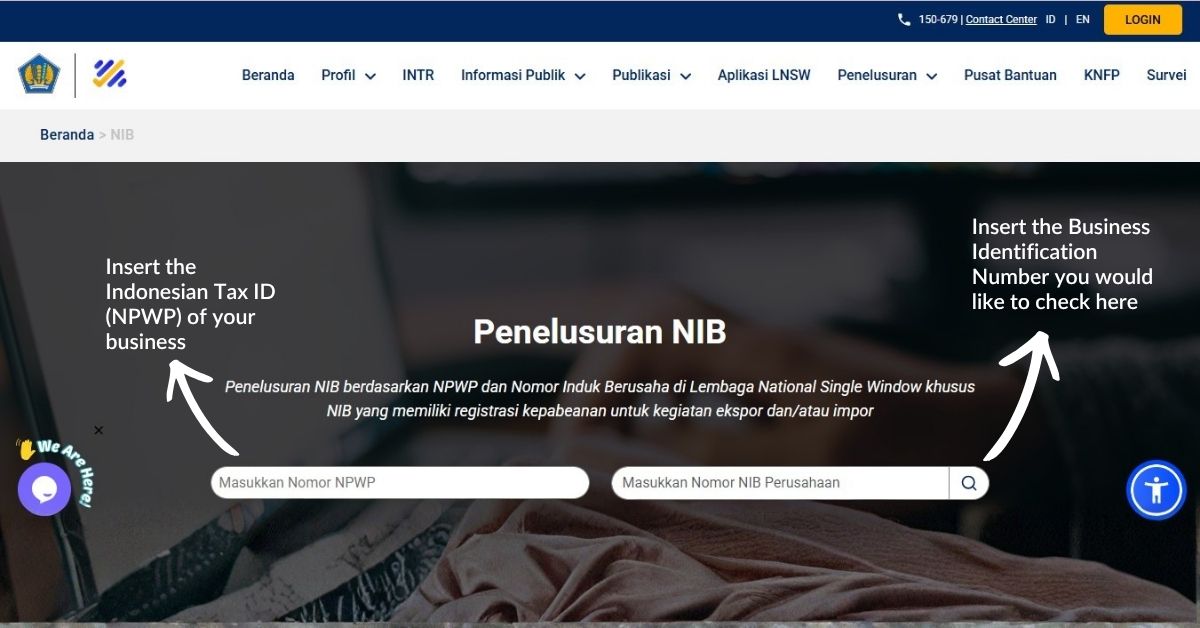
The first is the INSW (Indonesia National Single Window) portal, operated under the Ministry of Finance. This platform is particularly relevant for businesses involved in import and export activities or those registered with the Customs authority. To run a check, visit https://www.insw.go.id/nib, enter the company’s NPWP (Tax Identification Number) and NIB in the fields provided, and click the search icon. The system will return the company’s legal status and registration details.
The NSWI Portal
The second platform is the NSWI (National Single Window for Investment) portal, accessible at https://nswi.bkpm.go.id. This site is managed by BKPM and serves a broader range of investment-related licensing and non-licensing queries. To verify a registration, navigate to the “Tracking” menu from the homepage, enter the business licence number, and click search. The portal will display the current legal status of the entity in question.
Both platforms are publicly accessible and free to use, making them reliable first points of reference when conducting due diligence on a potential business partner or verifying your own registration.
Language Barrier: How to Bypass the Language Difference
For foreign investors and international partners, navigating Indonesian government portals can present an immediate challenge. Both the INSW and NSWI platforms are primarily in Bahasa Indonesia, and the data returned from a search, including licence classifications, risk levels, and status codes, will typically appear in Indonesian. This can make it difficult to accurately interpret results without local knowledge.
Using a browser-based translation tool offers a basic workaround, but it will not always render technical regulatory terminology correctly. Terms such as status aktif, izin operasional, risiko rendah, and KBLI codes each carry specific legal meanings that a direct translation may obscure or misrepresent.
For this reason, engaging a local consultant or legal advisor who is fluent in both the language and the regulatory framework is strongly recommended, particularly when the purpose of the NIB check is for investment due diligence, partnership verification, or pre-acquisition assessment. Getting this step right from the outset prevents costly misunderstandings further down the line.
How to Read Your Business Identification Number Check Results
Understanding what an NIB check result actually tells you requires more than confirming that a number exists in the system. The results displayed on the INSW or NSWI portals carry several layers of information that are relevant to assessing a company’s standing.
A valid NIB result will typically show the company name, its registered address, the KBLI business activity codes it is authorised to operate under, its risk classification (low, medium-low, medium-high, or high), and the status of any additional licences tied to the registration. An active status confirms the business is currently registered and in good standing with the OSS system.
Importantly, the absence of a valid NIB result, or a result showing an inactive or unverified status, does not always indicate fraud. It may reflect a registration that is still being processed, a recent amendment to the company’s details, or a mismatch between the information provided for the search and what is recorded in the system. In such cases, direct follow-up with the OSS system or BKPM is advisable before drawing conclusions.
Setting Up Your Company in Indonesia
For foreign companies looking to establish a presence in Indonesia rather than simply verify an existing one, obtaining an NIB is one of the first formal steps in the company incorporation process. Whether setting up a PT PMA (foreign-owned limited liability company), a representative office, or a local PT, the OSS system is the entry point for registration, and the NIB is the first credential issued upon completing it.
The registration process requires submitting key company information including ownership structure, registered capital, business address, and the intended scope of activities. Once submitted and verified, the OSS system issues the NIB, after which the company can proceed to apply for sector-specific operational licences and other regulatory approvals relevant to its business.
Getting this foundation right matters. Errors in the initial registration, particularly in the selection of business activity codes, can create complications for licensing, banking, and regulatory compliance down the road. Working with an experienced incorporation consultant ensures that the entity is structured correctly from day one.
Strategic KBLI Code Selection
One of the most consequential decisions in the NIB registration process is the selection of KBLI codes (Klasifikasi Baku Lapangan Usaha Indonesia), the Indonesian Standard Industrial Classification codes that define what business activities a company is legally authorised to conduct.
Each KBLI code corresponds to a specific category of business activity, and the codes assigned at registration directly determine which licences the company will need, what foreign ownership restrictions apply, and whether the business falls into a low, medium, or high-risk classification. Selecting the wrong codes, or too narrow a selection, can restrict a company’s operational scope in ways that are difficult and time-consuming to reverse.
A well-advised approach is to map out all current and anticipated business activities before registration and select KBLI codes that accommodate both.
Also read: How to Apply for Business Registration Number in Indonesia for PT PMA
Obtaining a Business Registration Number with Lets Move Indonesia
Given that certain KBLI codes are subject to restrictions under the Positive Investment List (Daftar Prioritas Investasi), which governs the degree to which foreign ownership is permitted in each sector, code selection also has direct implications for the company’s ownership and governance structure.
At Lets Move Indonesia, our team assists clients in identifying the most appropriate KBLI codes for their business model, ensuring that the NIB registration is not only compliant but strategically aligned with their long-term operational goals. Whether you are setting up a company for the first time or expanding an existing business in Indonesia, getting the NIB right from the outset is one of the most important steps you can take, and we are here to make sure you do.
Check Out Our Other Useful Articles About Business Updates Here!
Navigating BPOM Regulations for Market Entry in Indonesia: A Comprehensive Guide
Company Dissolution in Indonesia: A Guide for Foreign Investors
Company Registration Indonesia: What is PT, PT PMA or Representative Office