Nowadays, a brand and product identity is a crucial element to ensure its success; therefore, protecting your brand, logo or catchphrase should be a priority to all new businesses; which is why more and more businesses are beginning to legalize their business identity, by registering a trademark license in Indonesia!
What is a Trademark Registration Indonesia?
According to the Indonesia Law of Trademark Number 20 Year 2016, the meaning of Trademark is a brand which used on goods traded by someone or some people collectively agreed or legal entity to differentiate with other. Generally, Trademark registration to protects names, words, slogan and symbols that identify a business and for distinguishes from others brand. Protecting trademarks is an investment in customer goodwill, leading to greater customer satisfaction and higher sales.
Upon your trademark has been registered, you will be able to use ® symbol and another common symbol associated with trademark is ™ in order to demonstrate the products and enforceable by law. It also serves as notice to competitors that you are serious about protecting your trademark rights. Registering your trademark grants you protection and the exclusive right to use your trademark in connection to the products and services for which you have registered in a determined country or territory. The trademark application is to be submitted to the Directorate General of Intellectual Property Rights, Ministry of Law and Human Rights of the Republic of Indonesia.
Advantages of Register Your Trademark in Indonesia
Trademark protects against registration of similar marks for either goods or services.
Discourages others to using similar trademark
Serves as evidence of the validity and exclusive ownership of Trademark
Grants the right to use the ® symbol when the mark is used for the goods and services listed in the registration
To provide facilitating protection of the trademarks as business expands
Application Process to Register a Trademark in Indonesia
Filing a Trademark Application Form
You should file your application with the meaning of trademark (if any), details of colour and picture and translate the meaning of trademark into Bahasa if the trademark in English.
Administrative Examination
The Ministry of Law and Human Rights will check whether the application meets the requirements or not. If the applicant does not meet the requirements, the applicant has an additional 2 months to successfully edit the application.
Proceed the Registration Fee
Your Trademark will be published onto their website to see whether there will be any opposition from Others. If there is any opposition, the Applicant can issue a counter statement to reject the opposition. If there is no any opposition, the Applicant can continue the process into the next steps.
Examination
If the application of your Trademark Registration is rejected, the applicant can respond against the rejection around. After that, the Applicant should be wait around 3 months to get approval or refusal from the Indonesian government.
If the registration is approved the process can continue to the next stage.
Issue a Trademark Certificate
The Indonesian Government will give the notification for issuance of Certificate – whether the Certificate will be issued or not.
Issuance of Certificate of Registration
Within 3 months, the Ministry of Law will issue a Trademark Registration Certificate based on your application.
Validity of Indonesian Trademark
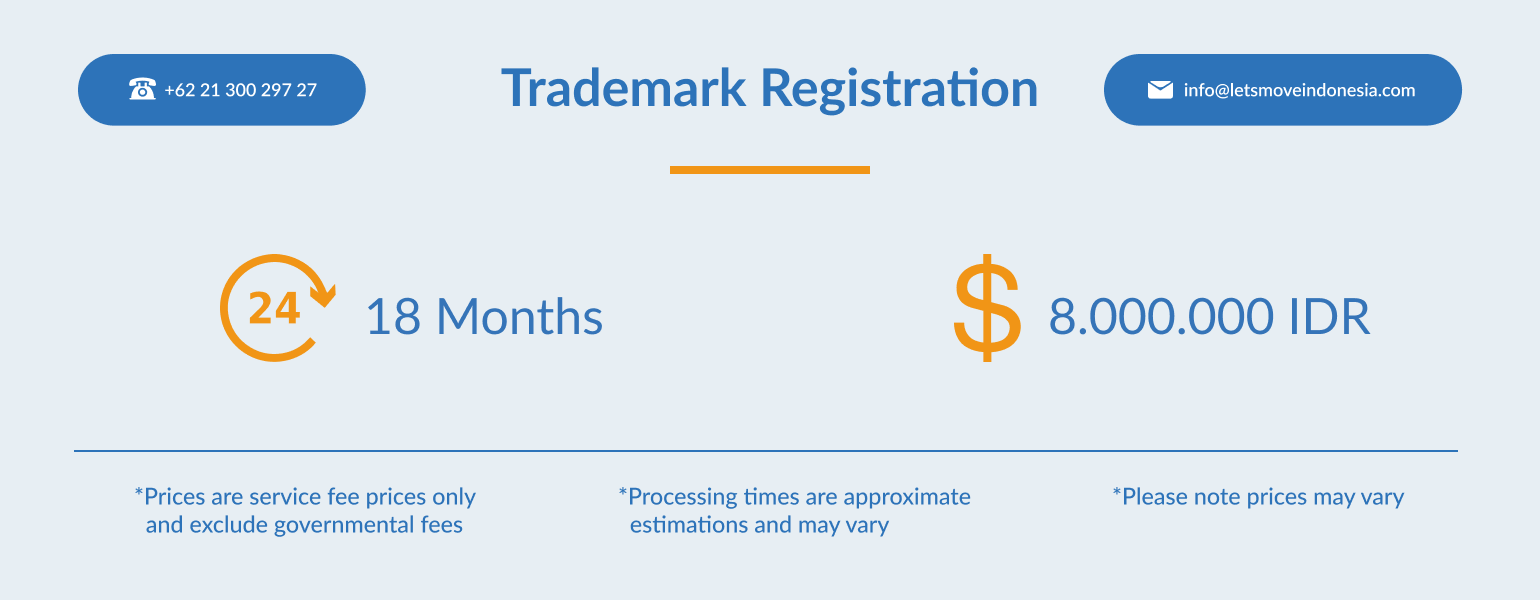
A registered Trademark can have legal protection for period of 10 years to the date of receipt of the registration of the Trademark concerned. The Trademark can be renewed within 6 (six) months before expiry date of trademark registration. The late filing of renewal application may be filed within 6 (six) months grace period after the expiry date of registration by paying a penalty.
Frequently Asked Questions
Can I modify or terminate a registered trademark?
Yes, modifications or terminations of the agreement must also be registered with the DGIP.
What are the potential consequences of not registering a trademark?
Unregistered trademark are not legally enforceable. This leaves both parties vulnerable to disputes and potential misuse of the trademark.
What is the legal basis for Trademark Registration in Indonesia?
Primarily, Law No. 20 of 2016 concerning Trademarks and Geographical Indications governs the registration process.
Can a business register a Trademark if the business registration itself is not yet registered?
No, the underlying trademark must be registered in Indonesia before the business can be registered.
Can we register the Trademark Registration online?
Absolutely! In Indonesia, trademarks can be registered online through the official website of the DJKI. You can conveniently conduct the entire process, from searching for existing trademarks to submitting your application, all through the online platform.
Remember, a strong trademark is a valuable asset for your business. Don’t hesitate to seek professional help to ensure your brand is adequately protected.
What are the specific requirements for the Trademark Agreement to be eligible for registration?
The agreement should be in writing, clearly identify the legal trademark, specify the scope of use (goods or services, territory), duration, and any quality control provisions.
Is there a specific format or template for the Trademark License Agreement?
A: While there’s no mandatory template, the agreement must contain the essential elements mentioned above and be drafted in clear language, preferably in Indonesian or with an official translation.
Are there any restrictions on the terms that can be included in a Trademark Agreement?
Yes, the agreement cannot contain terms that violate Indonesian competition law or public order. For instance, it cannot grant exclusive rights in a manner that stifles competition.
Can I submit a Trademark Registration if it's executed by foreign parties?
Yes, but the foreign party (licensor or licensee) must appoint a local Indonesian Intellectual Property Rights Consultant to handle the registration process on their behalf.
What is the role of the Indonesian Intellectual Property Rights Consultant in the process of Trademark registration?
The consultant prepares and submits the application, communicates with the DGIP, and addresses any queries or objections that may arise during the examination process.
What happens if there are objections to the registration of the Trademark?
The DGIP will notify the parties and give them an opportunity to respond. If the objections are not resolved, the registration may be refused.
Once registered, how long is a Trademark valid for?
The registration is valid for 10 years and can be renewed for additional 10-year periods.
Can Lets Move Indonesia assist with the Trademark Registration Process in Indonesia?
As a professional legal consultation in Indonesia, Lets Move Indonesia can connect you with our experienced professionals who can draft a comprehensive and compliant Trademark License Agreement tailored to your needs.
Prohibitions of registering a Trademark
Contrary to the Ideology of the State, Legislation, Morality, Religion, Public Order.
Only mention about the products but not mention Class clearly.
Contain or mislead the public about the origin, quality, type, size, purpose of the goods and/or services, or contains the name of a protected plant variety for goods and/or services.
Contain information which does not comply with the quality, benefits of goods and/or services.
Does not have any distinction from others Trademark.
Common name and/or general public property.
Want to know more about making a Trademark in Indonesia? Click here!
Other Popular Legal Licensing Services in Indonesia
Recognised as the Most Ethical Visa & Business Consultancy, Lets Move Indonesia has been the leading business consulting firm in Indonesia since 2016. We aim to be a complete resource for expatriates, giving reliable and professional assistance.
With 2027 approaching, companies operating in Indonesia should begin planning around the official public holidays and collective leave days in the country. On 15 September 2026, the Government of Indonesia formally established the 2027 holiday calendar through the Joint Decree of the Minister of Religious Affairs, Minister of Manpower, and Minister of Administrative and Bureaucratic […]
Indonesia’s investment framework is designed to make more business activities available to international capital while retaining restrictions in selected sectors. For foreign investors planning to establish a large enterprise or enter the Indonesian market, the first question is therefore not simply whether a sector is open, but under what conditions. The framework is commonly known […]
For companies operating in Indonesia, an annual report forms part of a company’s ongoing corporate compliance, providing an official record of its financial position, business activities and governance. In 2026, the timing matters more than usual. Since 1 June 2026, Indonesian limited liability companies (Perseroan Terbatas or PT) have been able to submit their Annual […]
Indonesia has become a favourite destination for travellers looking for tropical beaches, cultural experiences, wellness retreats and longer stays in Southeast Asia. But before booking that one-way flight or planning your island-hopping itinerary, it is worth checking which Indonesia visa for tourists matches your travel plans. The right visa depends largely on how long you […]
Indonesia has become an increasingly active destination for international exhibitions, trade shows, business forums and industry events, bringing together exhibitors, entrepreneurs and professionals from across the world. For foreign nationals planning to enter Indonesia for an exhibition, choosing the correct visa is an important part of the preparation. Indonesia’s current visa framework provides several visitor […]
Opening a bank account is one of the practical steps involved in establishing a personal or business presence in Indonesia. For investors and companies, a corporate bank account can support day-to-day payments, payroll, capital management and other business transactions. Both individuals and legal entities can open bank accounts in Indonesia, although the documentation and eligibility […]