Work KITAP (Indonesia Work Visa Permanent Stay Permit) – Who is it for and what are the benefits
If you are a long term employee working with the same company using a consecutive Work KITAS (limited stay permit) then maybe it is time you should start considering to apply for a KITAP.
The Work KITAP (Work Permanent Stay Permit / Kartu Izin Tinggal Tetap) is a product for foreign workers in Indonesia who intend to continue employment and work in Indonesia for the foreseeable future.
The work KITAP is similar to the Work KITAS, which allows foreigners the opportunity to stay in Indonesia, work an earn income, with the only 2 differences are:
Term validity: The Work KITAS is limited to 1 year, whereas the Work KITAP is for 5 years.
You must obtain a KITAS first and hold the same sponsor for 4 years. Once you have the same sponsor (with no breaks) you can then opt to convert to a KITAP.
The benefits of possessing the KITAP are that the visa has a maximum validity of 5 years, meaning you no longer need to renew a visa annually. As you only process the visa 1 time, you also save on costs. Our Work KITAP customers save a fortune, as well as time converting their KITAS to KITAP!
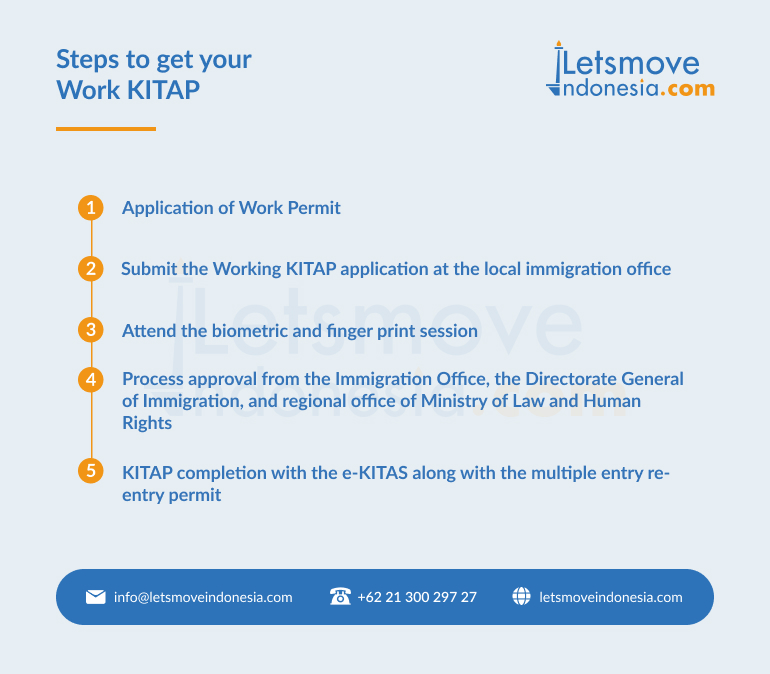
Steps to get your Work KITAP in Indonesia
Application of Work Permit
Submit the Working KITAP application at the local immigration office
Attend the Biometric and finger print session
Process approval from Immigration Office, Directorate General of Immigration, and Regional Office of Ministry of Law and Human Rights
KITAP completion with the E-KITAP along with multiple entry re-entry permit
Common Questions
If I change employer, can I continue my Work KITAP in Indonesia?
Generally, no. A Work KITAP is linked to its approved sponsor and employment arrangement. If you change employers, your existing sponsorship may no longer apply, meaning you may need to obtain a new visa or stay permit based on your new employment. The new employer may also need to complete the relevant Manpower and immigration requirements with the Ministry of Manpower and immigration authorities. Foreign nationals should review their documentation requirements before changing employment to avoid issues with their right to live and work in Indonesia.
If I am an investor in a company, is the Work KITAP the right visa for me?
Not necessarily. If you are a shareholder in an Indonesian company and meet the applicable investment threshold, an Investor KITAS or Investor KITAP may be more appropriate than a work-based visa. This can be particularly relevant for foreign investors holding shares in a PT PMA or another eligible Indonesian company. The appropriate visa category depends on the nature of your investment, activities and intended stay in Indonesia.
What is the difference between a KITAS and a KITAP?
A KITAS is generally a temporary stay permit for foreign nationals, while a KITAP is a longer-term permanent stay permit for foreign nationals. A KITAP may provide greater stability for eligible applicants who intend to remain in Indonesia for an extended period. Depending on the applicable category, a KITAP may be granted after holding a qualifying temporary stay permit for the required period or may be available KITAP directly in certain circumstances.
How long can I stay in Indonesia with a KITAP?
The validity of a KITAP depends on the applicable immigration category and the conditions attached to the permit. Certain KITAP holders may maintain their status for several consecutive years, subject to the relevant renewal and immigration requirements. Applicants should confirm the current rules through an official government source or with a qualified immigration consultant before making long-term residency plans.
Does a KITAP make me a permanent resident of Indonesia?
A KITAP is commonly understood as Indonesia’s long-term or permanent residence permit, and a holder may be considered a permanent resident for immigration purposes. However, KITAP status does not automatically grant Indonesian citizenship or all rights reserved for Indonesian citizens. The holder remains subject to the conditions of their immigration status and applicable Indonesian laws.
Can I leave Indonesia while holding a KITAP?
Depending on the type and conditions of the KITAP, eligible holders may be able to travel outside Indonesia using the relevant multiple exit facility or re-entry arrangement. Before travelling, it is important to confirm that your stay permit and immigration documents remain valid and that you have the necessary permission to return to Indonesia.
Can a KITAP holder work for any Indonesian company?
Not automatically. A KITAP itself does not necessarily authorise unrestricted Indonesian work. Employment remains subject to the applicable immigration, employment and Manpower regulations. If you intend to work for an Indonesian company, the employer and foreign worker may need to fulfil requirements administered by the Ministry of Manpower and other relevant authorities.
Can foreign investors obtain a KITAP through their investment?
Potentially, yes. Certain investment-based immigration routes may allow eligible foreign investors to obtain an Investor KITAS and, where the relevant conditions are met, an Investor KITAP. Investors in a PT PMA should assess their shareholding, investment structure and intended activities before selecting the appropriate route.
Can I obtain dependent visas for my spouse and children if I hold a Work KITAP?
Yes, eligible KITAP holders may be able to sponsor dependent family members, subject to the applicable immigration requirements. Spouses and children may qualify for a dependent visa category, allowing them to accompany the principal holder in Indonesia. The exact requirements depend on the family relationship, age and circumstances of each applicant.
Do I need to extend my KITAP?
A KITAP is intended to provide long-term residence, but holders must continue to comply with applicable immigration conditions and administrative requirements. Depending on the type of KITAP, you may need to extend or maintain the relevant stay permit and supporting documentation. Requirements can differ between categories, so holders should review their status before the permit reaches its expiry date.
Can I use my KITAP to establish or operate a business in Indonesia?
A KITAP does not automatically authorise every form of commercial activity. If you intend to establish or operate a business, you should determine whether your activities are permitted under your particular immigration status and whether additional business registrations or authorisations are required. For foreign investors establishing a PT PMA, immigration status should be considered alongside corporate, tax and regulatory obligations.
What should I check before applying for a KITAP?
Applicants should first identify the appropriate visa category, confirm whether they qualify for KITAP directly or must first hold a qualifying temporary stay permit, and prepare all required documentation requirements. It is also important to consider employment, investment, family and travel plans because these factors can affect the appropriate immigration route and subsequent obligations.
Recognised as the Most Ethical Visa & Business Consultancy, Lets Move Indonesia has been the leading business consulting firm in Indonesia since 2016. We aim to be a complete resource for expatriates, giving reliable and professional assistance.
To celebrate 11 years of leading Indonesia’s visa, legal, and business consultation industry, Lets Move Indonesia is thrilled to announce the return of our highly anticipated Refer a Friend Scheme! After a well-deserved break, we are bringing back one of our community’s favorite initiatives to say thank you for your ongoing trust and support. Why […]
Indonesia has confirmed that the next phase of mandatory halal certification (sertifikasi halal) will proceed from 18 October 2026, with the government preparing specific arrangements for certain businesses and product categories. The Halal Product Assurance Organising Agency (BPJPH) confirmed on 9 October 2026 that the implementation date would not be postponed, while indicating that the […]
A virtual office in Indonesia offers businesses a flexible way to establish a professional business address without leasing a conventional office. For foreign investors and companies entering the Indonesian market, virtual office solutions can reduce overheads, provide administrative support and help establish a business presence, subject to applicable regulations. However, not every business activity is […]
Indonesia and Egypt have announced new bilateral agreements covering diplomatic cooperation, visa arrangements, statistics, and maritime affairs, alongside plans to expand trade and investment. The developments could strengthen economic ties between the two countries, although the implications for Immigration Indonesia and Indonesia Visa requirements will depend on how the agreements are implemented. Indonesian President Prabowo […]
For foreign investors looking to expand into Indonesia, acquiring an established business can offer a faster route into the market than building a new operation from the ground up. An acquisition can provide access to existing customers, local expertise, operational infrastructure and distribution networks, while helping an investor establish a stronger position in Southeast Asia. […]
After years of helping our clients settle in, build businesses and make Indonesia home, we wanted to do something in return. As a thank you to our loyal customers, every eligible service purchased from LMI Consultancy/Lets Move Indonesia comes with two complimentary tickets to selected Social Expat events in Jakarta and Bali, with a combined […]