If you are a foreign investor planning to operate legally and generate revenue in Indonesia, the primary vehicle to do so is the PT PMA. PT PMA (Perseroan Terbatas Penanaman Modal Asing), also known as PMA Indonesia, is a common form of Foreign Owned Company in Indonesia.
What is a PT PMA Company in Indonesia?
This is a form of legal entity established under Indonesian law that allows foreigners to invest in Indonesia to open a business and generate revenue or profit. Since 2021, signing up for Foreign investment companies in Indonesia can be done online through the Online Single Submission (OSS) portal.
The establishment of a PT PMA is regulated by Company Law No. 40 of 2007 (Peraturan Perseroan Terbatas). This comprehensive legislation sets forth the legal framework for establishing and operating companies in Indonesia, including foreign-owned entities.
PT PMA vs. PT PMDN: What’s the Difference?
While both structures are limited liability companies, the fundamental difference lies in ownership and investment eligibility.
PT PMA (Foreign-Owned Company)
- Shares are owned partially or fully by foreign individuals or corporations.
- Must comply with the Positive Investment List and foreign ownership limits per business activity.
- Subject to minimum paid-up capital requirements, currently IDR 2.5 billion, and must show a minimum IDR 10 billion investment value per 5-digit KBLI.
- Eligible to hire foreign workers and sponsor work permits.
PT PMDN (Domestic-Owned Company)
- Shares are owned 100% by Indonesian citizens or Indonesian legal entities.
- Not restricted by foreign ownership limitations.
- Often used as a “local partner” vehicle, but foreign nominee arrangements are illegal.
- Lower structural requirements compared to PT PMA.
For foreign investors who intend to manage their own commercial operations legally, a PT PMA is the compliant and safest option.
5 Essential Tips to Establish a PT PMA in Indonesia Successfully
Setting up a PT PMA involves more than paperwork. It requires strategic planning, proper classification, correct licensing, and alignment with investment regulations. Here are the five key steps every foreign investor should consider:
1. Confirm the Business Activities of Your PT PMA
Your PT PMA must be built on clearly defined business activities. These activities are categorized through KBLI (Klasifikasi Baku Lapangan Usaha Indonesia) codes, which determine:
- Whether foreign ownership is permitted
- Required licenses, capital, and operational compliance
- Whether special approvals or additional certifications are needed
Under the Positive Investment List, certain industries allow 100% foreign ownership, for example:
- Management consulting
- IT and software development
- General trading (import/export)
- Web portals and digital services
Meanwhile, some sectors have limitations or require Indonesian partners, such as:
- Construction services
- Travel agencies
- Certain distribution activities
- And some sectors remain restricted for foreign ownership entirely.
Why this matters:
Choosing the wrong KBLI code can delay your licensing, disrupt your operations, or even invalidate your PT PMA’s eligibility. A precise KBLI selection ensures your business is compliant and ready for commercial activity.
2. Plan a Clear and Compliant Shareholding Structure
Every PT PMA must have at least two shareholders (foreign individual/foreign company/Indonesian individual/Indonesian entity). Before incorporation, clarify the roles within the Investment Coordinating Board, such as:
- Who will own how many shares?
- Will the ownership be individual or corporate?
- Is the structure compliant with foreign ownership limits?
In Indonesia, shareholding determines:
- Eligibility under the Positive Investment List
- Required minimum capital
- Licensing requirements
- Your long-term operational structure
Foreign investors frequently overlook this step and face issues later when restructuring, transferring shares, or adding new business lines.
3. Choose a Valid and Compliant Company Name
Before your PT PMA can be incorporated, you must register a company name that meets Indonesian naming rules:
- Must consist of three distinct words
- Must not use restricted or government-associated terms
- Must not duplicate or resemble existing company names
- Must not contain culturally sensitive or prohibited language
During Company Registration, your company name also affects the speed of approval at the Ministry of Law and Human Rights (MOLHR). Names that violate naming conventions often result in immediate rejection.
4. Complete All Legal Registration and Business Licensing Requirements
Once your business activities, shareholders, and name are confirmed, your PT PMA must complete mandatory legal registrations, including:
- Core Corporate Documents
- Deed of Establishment
- Approval from the Ministry of Law and Human Rights
- Company’s NPWP (Tax ID)
- NIB (Business Identification Number)
- Business and commercial licenses through OSS-RBA
- Sector-Specific Licenses
Depending on your activity, you may need:
- Import licenses (API-U or API-P)
- Halal certification
- Operational permits
- SIUP, SLS, or special industry licenses
Remember:
Since 2025, the regulations for foreign investment have tightened, including capital lock-up requirements, environmental screening, and expanded reporting obligations.
Without proper licensing, your company cannot operate legally, even if the PT PMA is already registered.
Also read: Business in Indonesia: BKPM Regulation for Investment Implementation in 2025 – 2026
5. Partner with a Trusted Legal and Corporate Consultant
Indonesia’s investment framework is highly regulated, and foreign investors must follow strict requirements regarding:
- Capital structure
- KBLI classification
- OSS-RBA licensing
- Import/export licenses
- Tax compliance
- Local manpower regulations
- LKPM reporting for foreign investment
Attempting to manage incorporation alone can lead to delays, inaccurate filings, or non-compliance that may result in business suspension.
This is why partnering with a licensed, reputable corporate consultant is essential.
Why Lets Move Indonesia Is the Trusted Partner for PT PMA Setup
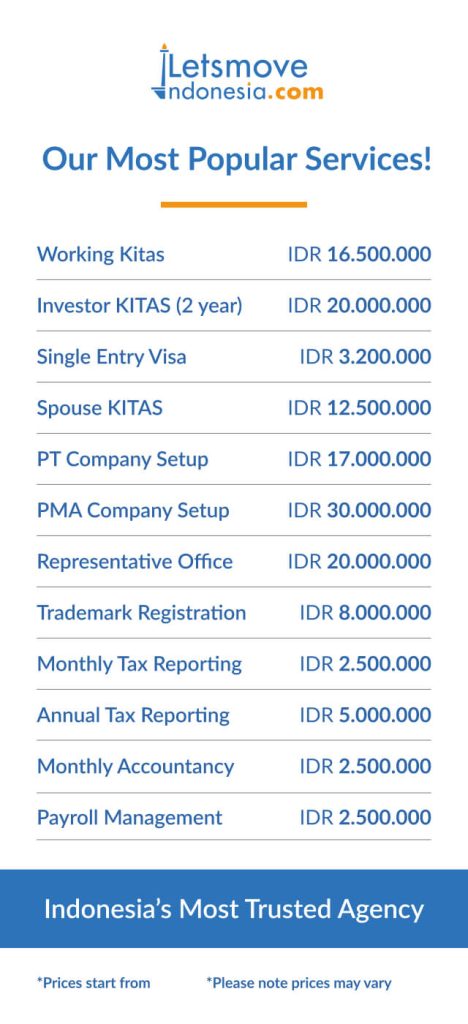
As Indonesia’s most transparent and trusted agency since 2016, Lets Move Indonesia has assisted thousands of foreign investors in establishing PT PMA and PT PMDN companies, with clear pricing, genuine expertise, and end-to-end support.
Our services include:
- PT PMA company formation
- KBLI and investment structure planning
- OSS-RBA licensing and legal compliance
- Import licensing (API-U / API-P)
- Tax registration and PKP setup
- LKPM reporting
- Visa, KITAS, and work permit sponsorship
We provide a complete and compliant incorporation experience, ensuring your company is legally ready to operate in Indonesia.
Speak with our consultants for a FREE consultation and start your PT PMA journey with confidence.
Frequently Asked Questions: Foreign Investment and PT PMA in Indonesia
1. Can a PT PMA be 100% foreign-owned?
Yes, depending on the business sector and the Positive Investment List. Many industries allow full foreign ownership, while others have caps or restrictions.
2. What is the minimum capital for a PT PMA?
As of BKPM Regulation No. 5/2025, PT PMA must have:
IDR 2.5 billion paid-up capital, AND
Minimum investment value of > IDR 10 billion per KBLI per project
3. Can I use local nominees to bypass foreign ownership restrictions?
No. Nominee arrangements are illegal in Indonesia and can result in company removal and legal penalties.
4. How long does it take to establish a PT PMA?
With clean documentation, incorporation typically takes 2–4 weeks, depending on licensing complexity.
5. Can a PT PMA hire foreign employees?
Yes. A PT PMA is allowed to hire expatriates and sponsor KITAS/Work Permits under approved positions.
6. Can I change business activities after incorporation?
Yes, but changes require updates to your Deed, OSS-RBA, capital structure, and sometimes commercial licensing.
7. What reports must a PT PMA submit to BKPM?
Every PT PMA must submit LKPM (Investment Activity Reports) quarterly or semi-annually, depending on company size.
Start Your Business in Indonesia Now. Setup A PT PMA With Lets Move Indonesia
Setting up a foreign-owned company in Indonesia is a major opportunity, but also a significant legal commitment. With the right structure, licensing, and expert guidance, your investment can thrive in one of Asia’s fastest-growing markets.
For complete support with PT PMA registration, legal compliance, licensing, and ongoing corporate needs, Contact Lets Move Indonesia today.