This article features insights from Givenia Turnip, Head of Legal Consultant of Lets Move Indonesia
Indonesia has entered a new chapter of economic dynamism. With investment flows rising, regulatory frameworks becoming more streamlined, and the digital economy accelerating, both local entrepreneurs and foreign investors are increasingly positioning Indonesia as their next growth frontier.
But as opportunities expand, so does the need for clarity. Company registration in Indonesia remains one of the most frequently asked topics among investors looking to enter the market. Understanding the differences between PT, PMA, and Representative Offices, and knowing which structure fits your strategy can significantly reduce risk and accelerate your business launch.
To help navigate this landscape, Lets Move Indonesia spoke with Givenia Turnip, our Head of Legal Consultant, whose extensive corporate legal experience has guided hundreds of companies through the incorporation process. With support from her Legal Associate, Nia, she breaks down everything you need to know about establishing a business in Indonesia in 2025.

LMI: To start, can you explain the different company options available to locals and foreigners?
Nia: Indonesia offers several company structures, each designed for different types of investors. For Indonesian citizens, the primary structure is the PT (Perseroan Terbatas), a Limited Liability Company. This is the standard vehicle for local entrepreneurs and has flexible classifications depending on capital and business scale.
For foreigners, there are two key options:
- PMA (Penanaman Modal Asing) – A Foreign-Owned Limited Liability Company, which allows expatriates to hold partial or full ownership.
- KPPA (Kantor Perwakilan Perusahaan Asing) – A Representative Office, enabling foreign businesses to establish presence without conducting commercial transactions.
Each structure comes with distinct requirements, benefits, and limitations depending on your long-term business plan.
PT REGISTRATION (Local Company)
LMI: What are the requirements to register a PT company?
Nia: A local PT requires the following details:
- Minimum two Indonesian shareholders
- A President Director and a President Commissioner, who must also be Indonesian
- Valid KTP (ID card) and NPWP (tax ID) for all shareholders and executives
- A registered business address, which can be a physical office or, in some cases, a virtual office depending on the business classification
This structure is strictly for Indonesians, although PT companies are permitted to hire foreign directors or commissioners if their capital meets the minimum requirement of IDR 1 billion.
LMI: What about the capital requirements for a PT?
Nia: PTs fall under two broad categories:
- UMK (Small–Medium Enterprises):
Capital between IDR 50,000,000 and IDR 5,000,000,000 - Non-UMK (Larger Enterprises):
Capital above IDR 5,000,000,000
The capital requirement is a formal indicator of business scale. In practice, it affects licensing, hiring eligibility, and industry limitations.
LMI: And the advantages of PT over PMA?
Nia: PTs benefit from greater flexibility in business classifications. Some industries are restricted to foreign ownership under Indonesia’s Positive Investment List — meaning only PTs (local-owned companies) can operate in those sectors. PTs also tend to face less regulatory oversight compared to PMAs.
PMA REGISTRATION (Foreign-Owned Company)
LMI: For foreign investors, what exactly is a PMA and why is it important?
Nia: A PMA (Penanaman Modal Asing) is the only legally recognised company structure that allows foreigners to own and operate a commercial business in Indonesia. This structure enables expats and international investors to fully participate in Indonesia’s economy under a regulated, transparent framework overseen by the Investment Coordinating Board (BKPM).
A PMA can be established in two forms:
- Fully foreign-owned PMA, where all shareholders are foreign individuals or foreign companies
- Partially foreign-owned PMA, formed as a joint venture with Indonesian partners
Ownership percentages depend on your business classification. Some industries permit 100% foreign ownership, while others impose limits based on Indonesia’s Positive Investment List.
LMI: What are the requirements to register a PMA company?
Nia: Requirements vary slightly depending on the ownership structure. Typically, to set up a company in Indonesia, you must initially appoint minimum two shareholders.
For a fully foreign-owned PMA, you must have:
- At least two foreign shareholders (either individuals or foreign companies)
- Valid passports for individuals or corporate registration documents for foreign companies
- A registered company address in Indonesia. In certain industries, virtual offices are acceptable
For a partially foreign-owned PMA, you must have:
- At least one foreign shareholder
- At least one Indonesian shareholder
- Supporting identification documents for all shareholders
Regardless of your share composition, the registration process is conducted through the OSS (Online Single Submission) system, which issues your Business Identification Number (NIB) — the certificate that legally confirms your business registration number and authorises your company to operate.
LMI: What about the investment requirement?
Nia: By law, PMA companies must declare a total capital investment of IDR 10 billion, with minimum total paid-up capital of IDR 2.5 billion excluding land and buildings. This threshold ensures that foreign investment contributes meaningfully to Indonesia’s economic development. It also reflects the government’s commitment to attracting high-value projects rather than small trading operations.
LMI: How can investors fulfil the paid-up capital requirement?
Nia: Investment for PMAs can be fulfilled in several ways:
- Cash deposits transferred into the company’s Indonesian corporate bank account
- Capitalised assets, such as machinery, equipment, vehicles, or property
All capital injection activities must be reported through BKPM’s investment system, which monitors compliance and ensures transparency between foreign investors and the Indonesian government.
LMI: What if a foreign investor cannot meet the paid-up capital requirement?
Nia: The IDR 10 billion requirement is a regulatory standard. However, depending on your business model and long-term goals, there may be alternative structures, including:
- Setting up a Representative Office (KPPA) to conduct research or market exploration
- Forming a local PT with Indonesian partners
- Using phased investment strategies as part of a long-term expansion plan
Every investor’s situation is different, so it’s best to consult with legal professionals before finalising your structure.
LMI: Are there industries that foreigners cannot register under a PMA?
Nia: Yes. Under Presidential Regulation No. 49/2021, several sectors remain restricted or closed to foreign ownership, including:
- Specific micro-scale businesses
- Public sector functions
- Industries considered strategic for Indonesia’s national interests
These limitations are enforced through the Positive Investment List, which classifies which sectors are open, partially open, or restricted.
LMI: If my business falls under a restricted classification, what options do I have?
Nia: Foreigners can still participate by being appointed as a:
- Director
- Commissioner
in a locally owned PT. This is a common strategy for foreign professionals whose industries do not allow PMA ownership but still require international expertise.
LMI: What are the key advantages of establishing a PMA in Indonesia?
Nia: PMAs offer several long-term strategic benefits:
- Full operational control of your business
- Eligibility for an Investor KITAS (1–2 years, cost-effective, fewer restrictions than a work visa)
- Ability to legally generate revenue, sign contracts, and participate in the Indonesian market
- Stronger legal standing and credibility in both local and international business environments
For foreign entrepreneurs wanting autonomy, scalability, and a stable business foundation, the PMA remains the strongest and most future-proof option.
LMI: How does OSS fit into the PMA setup process?
Nia: The OSS (Online Single Submission) system is Indonesia’s centralised digital platform for all business licensing.
Through OSS, your company will receive:
- NIB (Business Identification Number)
- Business license certificates relevant to your sector
- Access to post-licensing requirements such as operational permits
- Registration for tax and employment obligations
The platform integrates directly with BKPM, the Ministry of Law and Human Rights, and the Ministry of Manpower — allowing a faster, more transparent registration process.
Working with a consultant ensures that every OSS submission is accurate, reducing the risk of delays.
LMI: What does the overall registration process look like when setting up a PMA?
Nia: The process typically includes:
- Determining your business classification
- Preparing shareholder and director documentation
- Drafting the Deed of Establishment with a notary
- Uploading details to the OSS system to receive your NIB
- Registering operational licenses and sector-specific permits
- Opening a corporate bank account
- Fulfilling foreign investment reporting obligations through BKPM
With professional guidance, PMA setup can be completed smoothly within a predictable timeline.
REPRESENTATIVE OFFICE REGISTRATION (KPPA)
LMI: What exactly is a KPPA?
Nia: A KPPA is a non-commercial entity for foreign companies wishing to:
- Conduct market research
- Coordinate projects
- Build visibility before investing
- Represent their head office without commercial activities
It’s ideal for companies exploring Indonesia without committing to full investment.
LMI: What are the requirements for setting up a KPPA?
Nia: You need:
- A foreign company appointing a Representative Executive
- Valid identification (passport for foreigners, KTP for Indonesians)
- A registered address
No shareholders or capital are required.
LMI: Is capital investment required?
Nia: No. Since KPPAs cannot generate profit, issue invoices, or engage in sales, they have no minimum capital requirements.
LMI: What are the advantages and disadvantages of KPPA vs PMA?
Nia: There are definitely quite the array of benefits of registering a KPPA, such as:
- No capital requirement
- Faster setup
- Lower risk
- Ideal for early-stage market testing
However, there are also several advantages of setting up a PT PMA in terms of profit generation:
- Cannot earn revenue
- Cannot sign commercial contracts
- Cannot hire foreigners for operational roles
If you are committed to running a business in Indonesia, PMA is always the preferred structure.
GENERAL BUSINESS REGISTRATION QUESTIONS
LMI: Do you need a physical address for a company in Indonesia?
Nia: Yes. Every legal entity must have a registered domicile. Depending on the nature of the business, virtual offices may be permissible.
LMI: Are additional licenses required for certain industries?
Nia: Absolutely. Many industries require:
- Operational Permits
- NIB (Business Identification Number)
- Sector-specific certifications (e.g., education, construction, food & beverages)
We always assess your business classification to identify all required licenses.
LMI: Are there ongoing obligations after establishing a company?
Nia: Yes. These include:
- Monthly and annual tax reporting
- Quarterly investment reports through OSS
- Permit renewals
- Compliance maintenance
Failure to comply may lead to penalties or suspension.
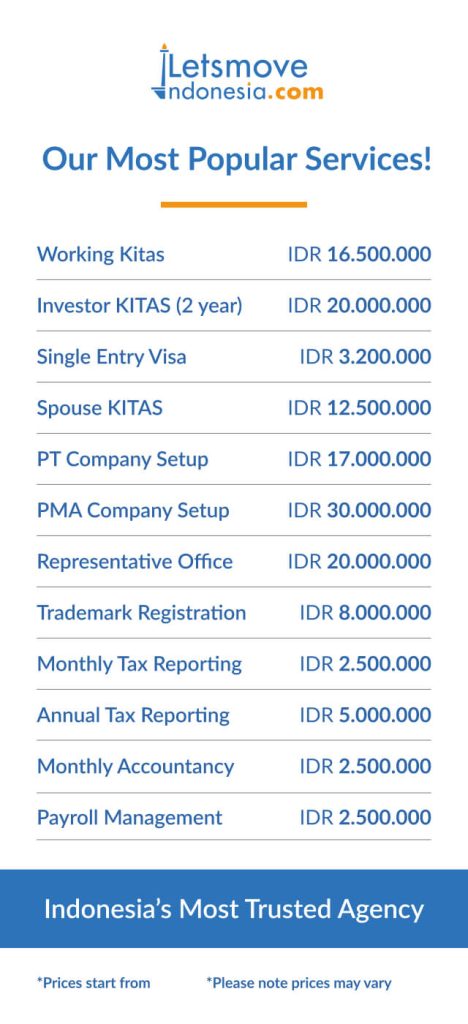
LMI: How much does it cost to register a company?
Nia: Costs vary widely depending on:
- Company type (PT, PMA, KPPA)
- Business sector
- Location-specific regulations
- License requirements
We tailor quotations after assessing your business model.
LMI: And what sets Lets Move Indonesia apart from other agencies?
Nia: There are several key factors:
- We offer up to 50% lower prices compared to many national agencies
- We are the only consultancy in Indonesia that openly advertises our prices
- We provide free 1-hour consultations
- We have legal experts in all offices
- We were named Best Visa & Business Consultancy in Indonesia
- We prioritise transparency, compliance, and client trust
If You Need Help, What’s Next?
Nia: Anyone needing additional information can visit our Jakarta office in Bellagio Mall, Mega Kuningan, or contact us through our website. Our Company Establishment page contains full details and fixed pricing.
About the Expert: GIVENIA TURNIP
Givenia Turnip is the Head of Legal Consultant at Lets Move Indonesia, with extensive expertise in corporate law, foreign investment, licensing, and compliance.
Her leadership has helped thousands of clients navigate the complexities of expanding into Indonesia. Along with other professional consultants in Lets Move Indonesia, we support on company establishment, OSS compliance, and sector-specific licensing.